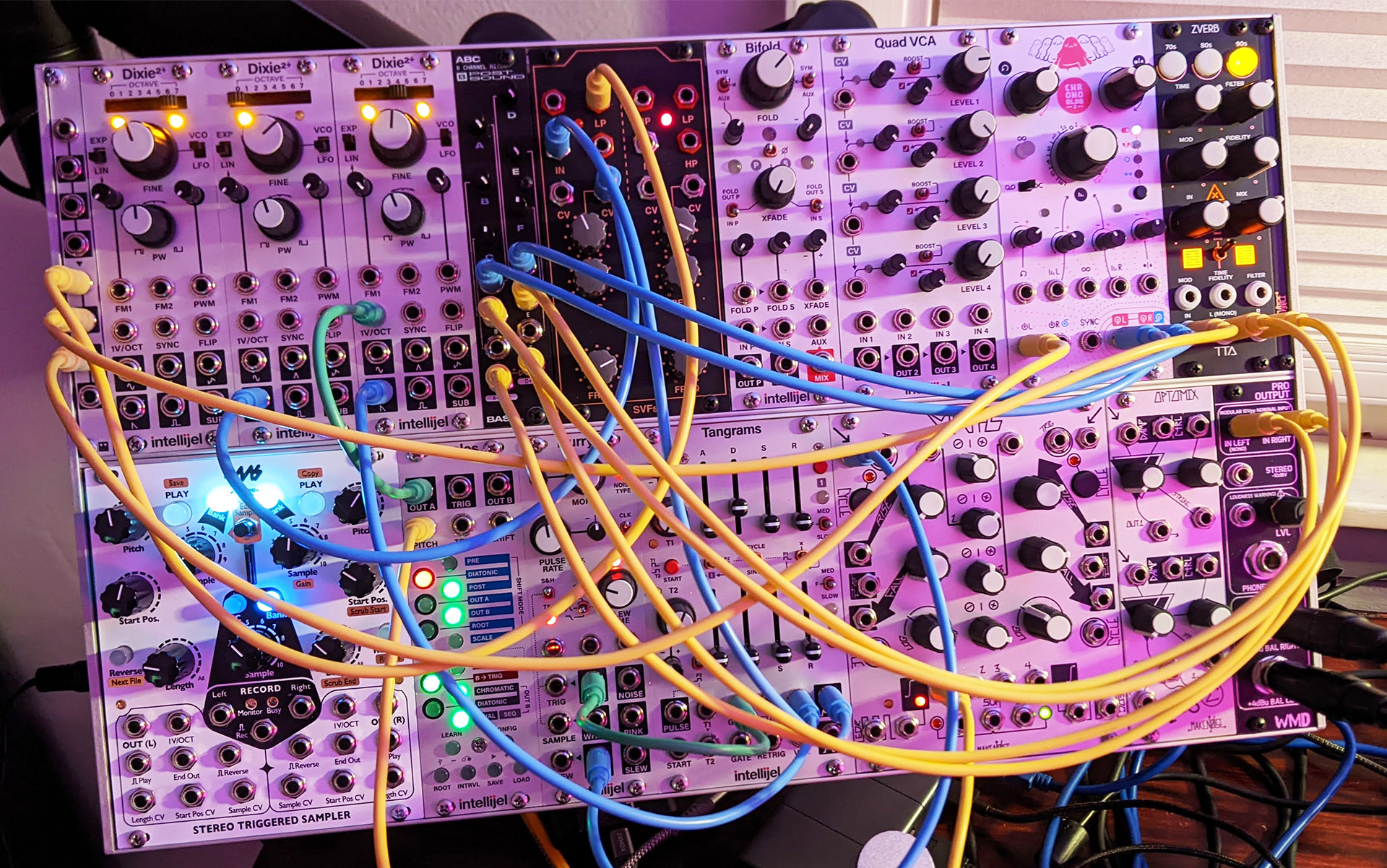
The Modular Synthesis and Sound Design Workstation is a complex, delicate, and sophisticated instrument designed to create distinct, unique, and fascinating sound effects, soundscapes, and musical phrases or compositions. The modules in the workstation’s rack were organized by Midwest Modular for the purpose of educating students about synthesis and sound design and well as provide a flexible system for professional use. Training is required prior to using the workstation and please handle the device with care.
Please review the information below describing each module in the system. Links will be provided to complete documentation in PDF form when they are available. A “getting started” example patch will also be defined to help you along in your journey.
Buff Mult | Dixie 2+ | ABC Mixer | Super Synthesis SVFs | Bifold | Quad VCA | Chronoblob 2 | ZVERB | 4MS STS | Scales | Flurry | Tangrams | MATHS | Optomix | Pro Output
Top Row Left to Right
Intellijel Buff Mult
Turn one audio or CV signal into six copies, or two signals into two sets of three. This is very useful when setting up all kinds of patches where you want to send a signal source to multiple destinations simultaneously.
Features
1. Top section normalled to bottom section. This means that one audio or CV signal can be duplicated six times, or two separate signals can each be multiplied three times.
2. Active buffered design ensures that voltage accuracy is maintained from an input to all outputs, and that they are electronically isolated from faults or shorts.
3. Slim 2HP footprint
Manual
Click here to download a PDF version of the manual
Intellijel Dixie 2+ (three of these oscillators next to each other in the rack)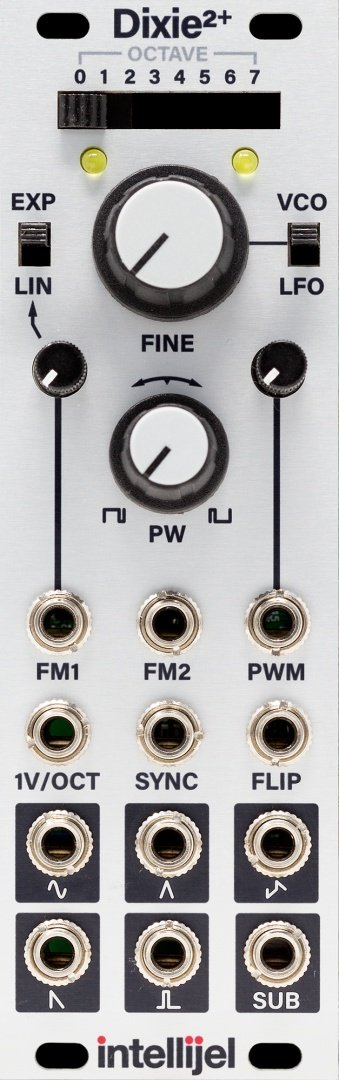
The Dixie 2+ is a larger variant of the classic Dixie 2. Using the same great triangle core oscillator, it adds a number of features to make it even more versatile with only a modest increase in size. The Dixie 2+ makes a perfect primary oscillator for a modular system, or a great companion for the Rubicon 2.
Features
1. 8-position octave switch for quick setting of coarse tuning.
2. Fine tuning knob that converts into a coarse knob when in LFO mode.
3. Dual FM inputs, with FM1 attenuator and switch to select between exponential and linear mode.
4. Pulse width control with attenuator.
5. Reset to 0 V hard sync input, ideal for percussive sounds or modulation.
6. Flip sync circuit similar to but improved from the Dixie II.
7. 6 waveform outputs: sine, triangle, zigzag, saw, pulse and suboctave.
Manual
Click here to download a PDF version of the manual
ABC
ABC is a simple 6 channel signal mixer. It has 6 inputs – A,B,C,D,E and F – and two outputs – A+B+C – which is mixed in to the D+E+F output if nothing is inserted in the A+B+C jack. ABC is designed to mix audio signals, but can be modified to mix CV signals instead. There are 6 solder jumpers on the back side, which can be connected to turn the abc mix into a CV mixer.
There are also 3 jumpers on the back side which can be used to normalize inputs A to D, B to E and C to F. This is useful if you would like to use the abc mix as a 3 channel stereo mixer (using both outputs and having separate volume control for left and right channel).
Features
– 6 channel mixer
– 6 inputs A,B,C,D,E,F
– 2 outputs A+B+C and D+E+F (A+B+C is mixed into D+E+F if no jack is inserted in A+B+C)
– 3 jumpers to select normalization of inputs A to D, B to E, C to F (useful for stereo mixing)
– Inputs are AC coupled
– There are solder jumpers for changing the inputs to DC coupling (than it can be used for mixing CV signals)
– Front panel from oak wood
Manual
Click here to download a PDF version of the manual
Super Synthesis SVFs (state variable filter)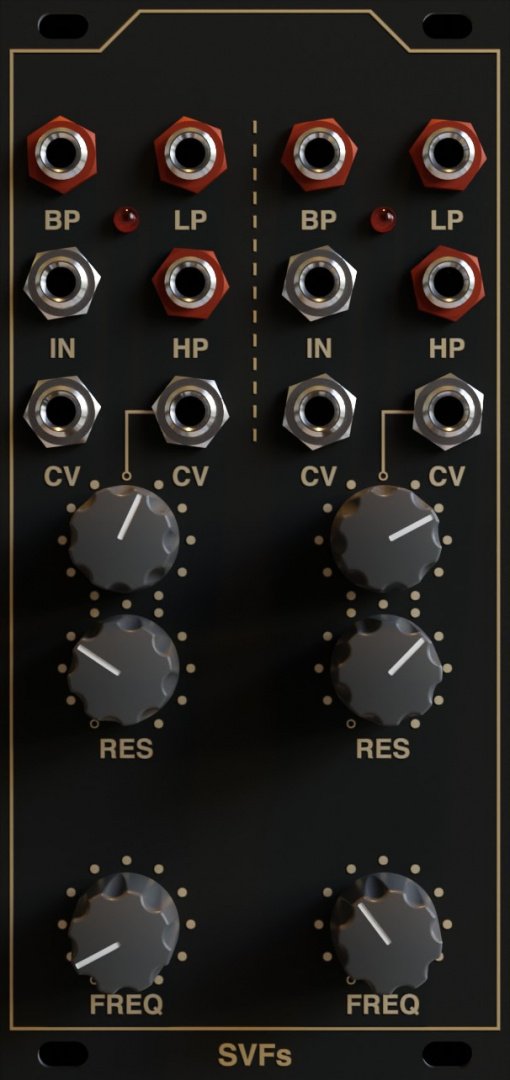
SVFs is a dual voltage-controlled State Variable Filter. Each filter has 1 signal input, 2 control voltage inputs with one attenuverter, and 3 signal outputs: Lowpass, Highpass, and Bandpass. When the resonance control is turned fully clockwise, the filter will self-oscillate, yielding a sine wave on the three outputs, 90 degrees out of phase with each other. SVFs’ signal inputs are DC coupled, so the filters can process both audio and control voltages. Great for making slewed and resonant envelopes and sequences.
Manual
Click here to download a PDF version of the manual
Bifold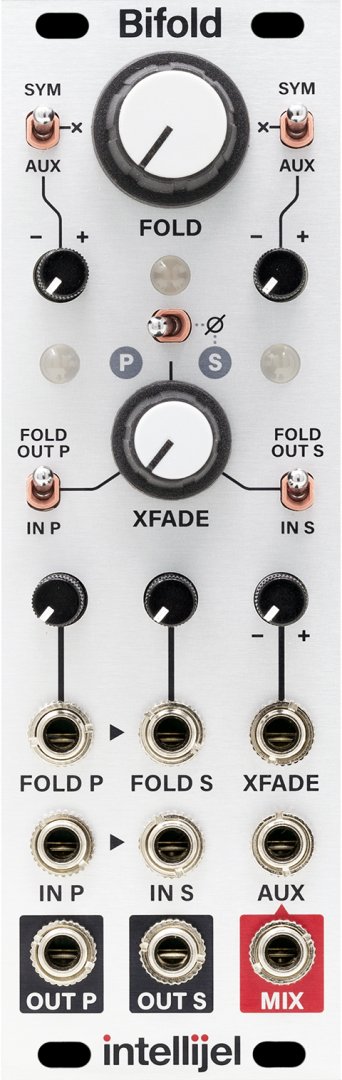
Bifold is a unique dual channel wavefolder with numerous feedback and routing options along with CV control. Mix, blend and crossfade the two different folder flavours into a rich stew of unique waveforms and harmonic movement. It is the first wavefolder to offer simultaneous, independently controllable serial and parallel folder circuits.
Ring modulation, blending, crossfading, complex noise generation, feedback modulation, cascaded folding and so much more are all possible thanks to the strategically placed routing switches, jack normals and attenuators and other control options. This is a module that invites much exploration and discovery and pairs well with almost any kind of modulation and sound source.
Manual
Click here to download a PDF version of the manual
Quad VCA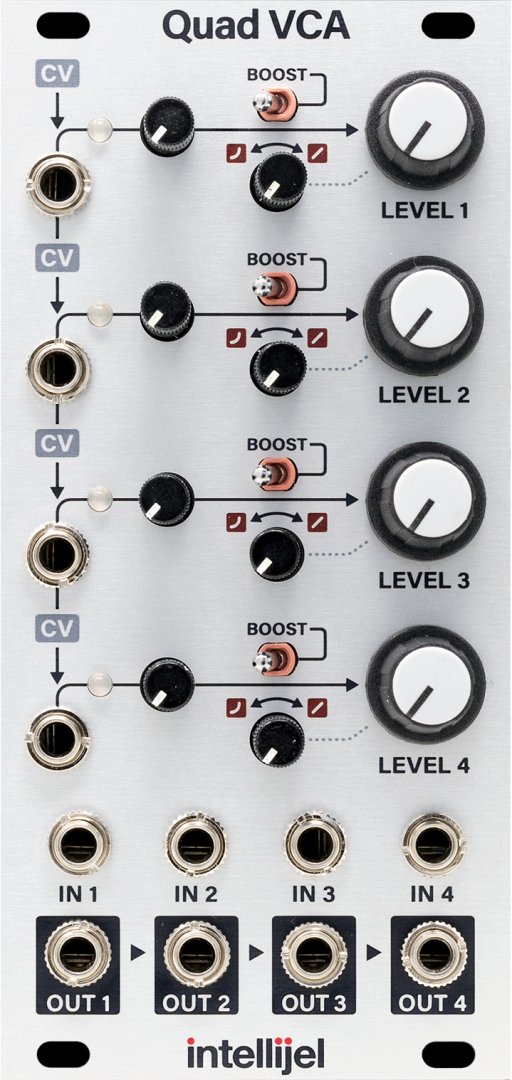
The Quad VCA comprises four channels of voltage controlled amplifiers. Each channel is equipped with a 6db boost, a LEVEL control, and the CV input response can be swept between linear and exponential. Additionally, the outputs of these channels are cascaded from left to right, allowing Quad VCA to function as a four channel mixer.
Features
1. Manual LEVEL control per VCA which is convenient when using the module as a mixer or for biasing when CV modulating the VCA with a bipolar LFO.
2. Dedicated CV attenuators with dual color LEDs for monitoring bipolar CV signals.
4. Continuously adjustable response from linear to exponential per VCA.
5. Each CV input is normalled to the adjacent one for cascaded control.
6. Each output is normalled to the mix input of the adjacent one which allows you to use adjacent sets as submixes or the 7. fourth output can be used as a main mix output when none of the other outputs are patched.
8. Each VCA has a boost switch that increases the output level by approximately 6dB (double).
Manual
Click here to download a PDF version of the manual
Chronoblob 2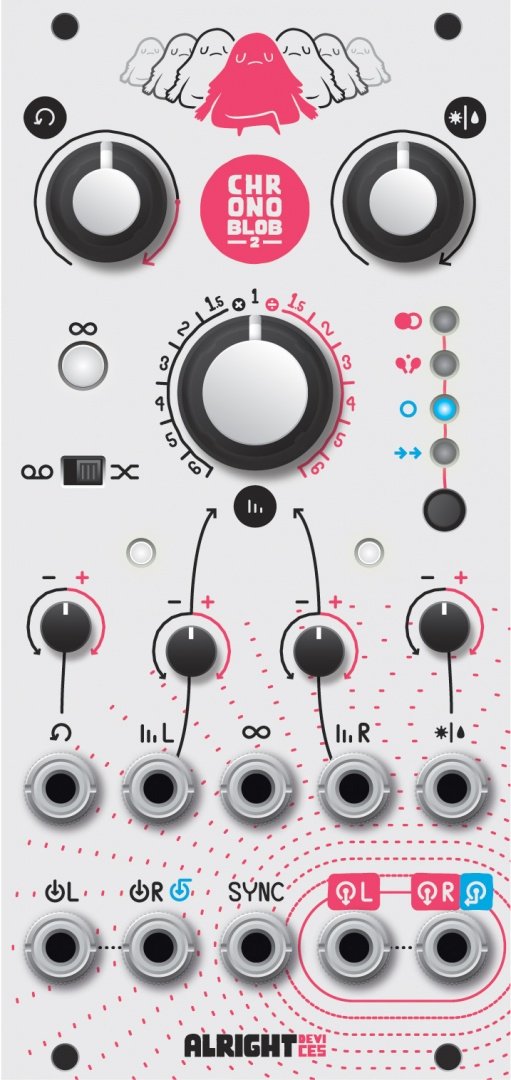
Chronoblob2 is a digital delay module with many features and modes. Patch one into the SYNC input and choose a multiplier or divider for rhythmic delays. Or leave SYNC unpatched for access to continuously variable delay times. Chronoblob2 offers four different delay modes! Dual delay mode provides two separate delays with shared controls. Ping-pong mode extends this intermingling even further by placing each delay in the feedback loop of the other.
Single delay is the classic Chronoblob mode with feedback SEND and RETURN. Patch in a lowpass filter for smooth, shadowy echoes, or get weird with a wavefolder or any other effect! Cascade delay mode expands on this archetype by also placing the second delay inside the feedback loop of the main delay, creating a wild multiplying echo effect. Chronoblob2 offers an INFINITE LOOP button and gate input to shut off the delay inputs and lock the feedback at 100%.
Manual
Click here to download a PDF version of the manual
ZVERB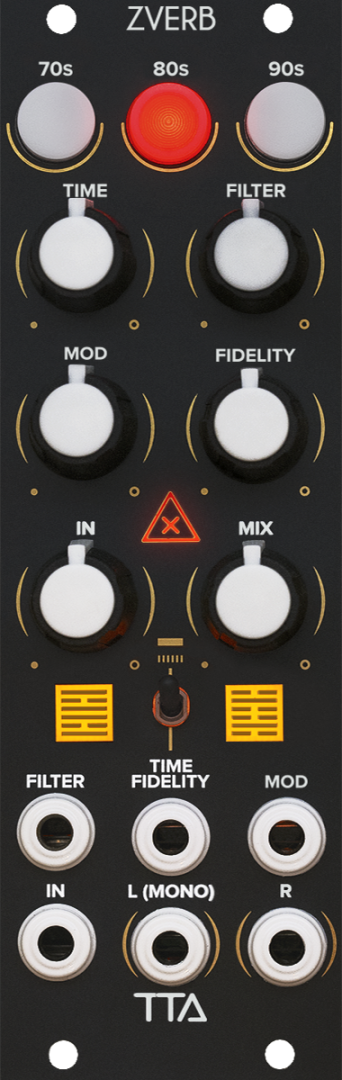
ZVERB is a collection of all new reverb algorithms developed by Tiptop ranging from typical reverbs to more complex effects that combine delay and pitch shifting with reverb. The effects are grouped by decades based on either the era an algorithm was introduced or the time when the effect was most popular. This variety of reverbs covers small to epic size spaces with the addition of shimmering, feedback tunneled pitch shifting, tape delay drivers, gated reverbs and a lot more. Analog clocking of the DSP chip and CV over the parameters enables even more experimentation. This is a collection inspired by the best from the past right at your fingertips.
Manual
Click here to download a PDF version of the manual
Bottom Row Left to Right
Stereo Triggered Sampler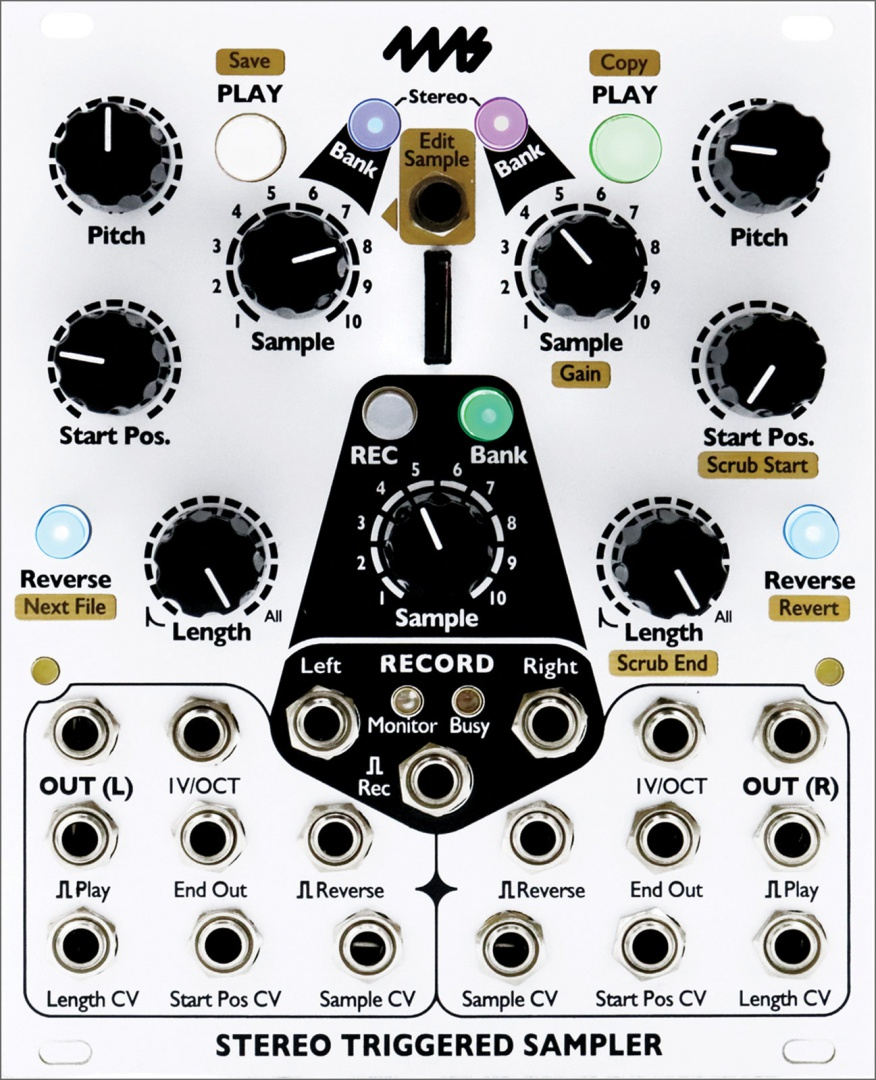
The Stereo Triggered Sampler is a high fidelity, two-channel stereo sample recorder and playback module. The STS can record high quality stereo files, while simultaneously playing two different stereo files. A maximum of 600 samples can be loaded from the removable/swappable microSD card, in a variety of formats up to 96kHz/32-bit/stereo WAV. All sample parameters (1V/oct pitch, sample file selection, length, and start position) are CV controllable.
A maximum of 600 samples can be loaded at once, arranged into banks of 10 samples each. Samples and banks can be re-arranged on the fly using the simple on-board Edit features. Newly recorded samples can be instantly played back and re-pitched, reversed, chopped up, etc… the result of which can even be bounced down and re-recorded to as a new sample! Sample files are limited to 4GB each, which is over 6 hours at 44k/16b/stereo.
Features
1. Hundreds of samples included on microSD card
2. Extremely quiet, low noise and low jitter design
3. Stereo or Mono operation:
4. Stereo mode: Two stereo files are mixed and played through the L and R output jacks (L+L and R+R)
5. Mono mode: Each file is mixed to mono and output through the channel’s output jack (L+R and L+R)
6. Firmware can be updated by playing an audio file into the STS
Manual
Click here to download a PDF version of the manual
Scales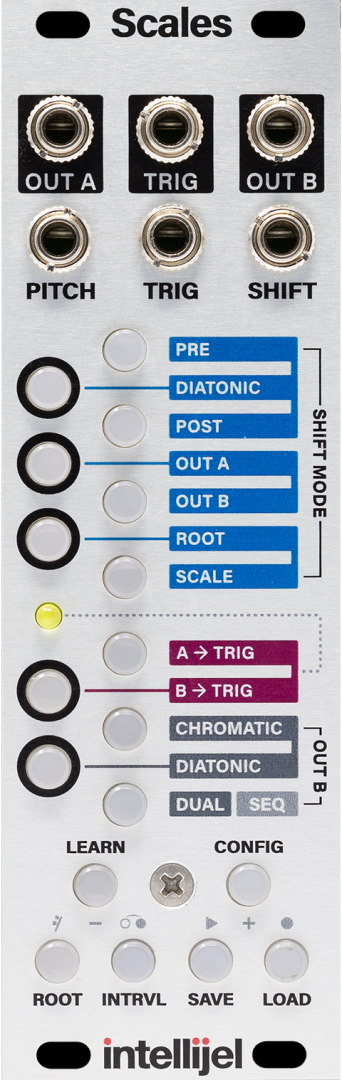
Scales is an 8hp dual-channel note quantizer and step sequencer. Fundamentally, it takes an input voltage, quantizes it to notes in a user-defined scale, and sends that quantized voltage to an output, where you can use it as a melodic pitch source for oscillators or any other module that expects to see discreet note values at its input.
Scales goes far beyond the fundamental, allowing you unprecedented control of the pitches and intervals hiding inside your control voltages; turn LFO’s into arpeggiators; random voltages into harmonic counterpoint; and unquantized external CV sequencers into chromatically tuned note sequencers.
Features
1. SHIFT/PITCH inputs and A/B outputs operate in a -10v to +10v range with 1v/oct scaling
2. 1-octave keyboard for selecting scale notes in real time and LED buttons provide visual feedback of quantizing
3. Save and recall up to 35 different scales and sequences, arranged in 5 banks (black keys) of 7 scales each (white keys)
4. 35 factory scale patterns included
5. High resolution precision DAC for accurate pitch generation
6. Adjustable trigger delay
7. Input filtering eliminates jitter and glitches
8. Low latency with a fast ARM processor
9. LEARN function allows you to monitor external sequences or inputs and learn notes from them
10. Tuning mode so you can conveniently tune connected VCOs
11. ROOT function allows you to set root with or without shifting your current scale to match
12. USB port on back for easy updates of firmware
Manual
Click here to download a PDF version of the manual
Flurry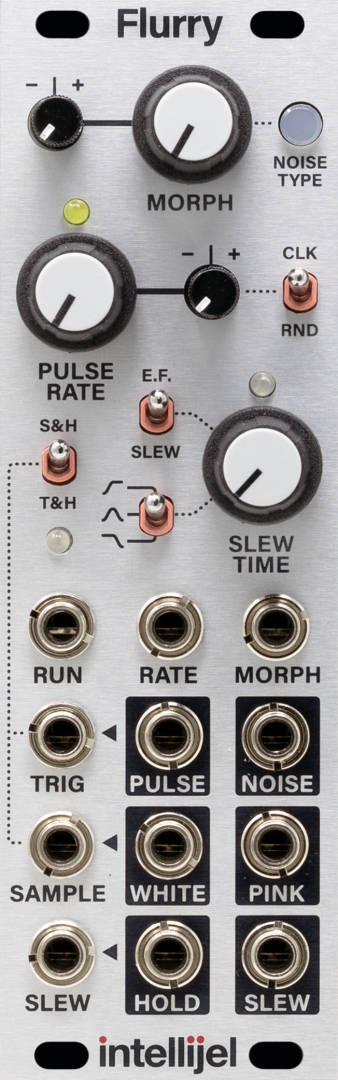
Flurry collects and connects a number of practical modular synthesis tools, focussed on clocks, noises, and randomness to create a module that is rife with opportunities for exploration and experimentation. Equally capable as a synthesis source, modulator, clock, or signal modifier; It is bound to find a way to bring new life and dimensions to your synth patches.
Features
1. A clock and random pulse source with adjustable and modulatable rate
2. Accurate pink and white noise sources
3. Analog sample & hold and track & hold circuits with very low droop
4. Analog slew with adjustable slew time and edge selection (rising edge, falling edge, or both)
5. Envelope follower
6. 16 noise synthesis algorithms, each with 2 parameters.
Manual
Click here to download a PDF version of the manual
Tangrams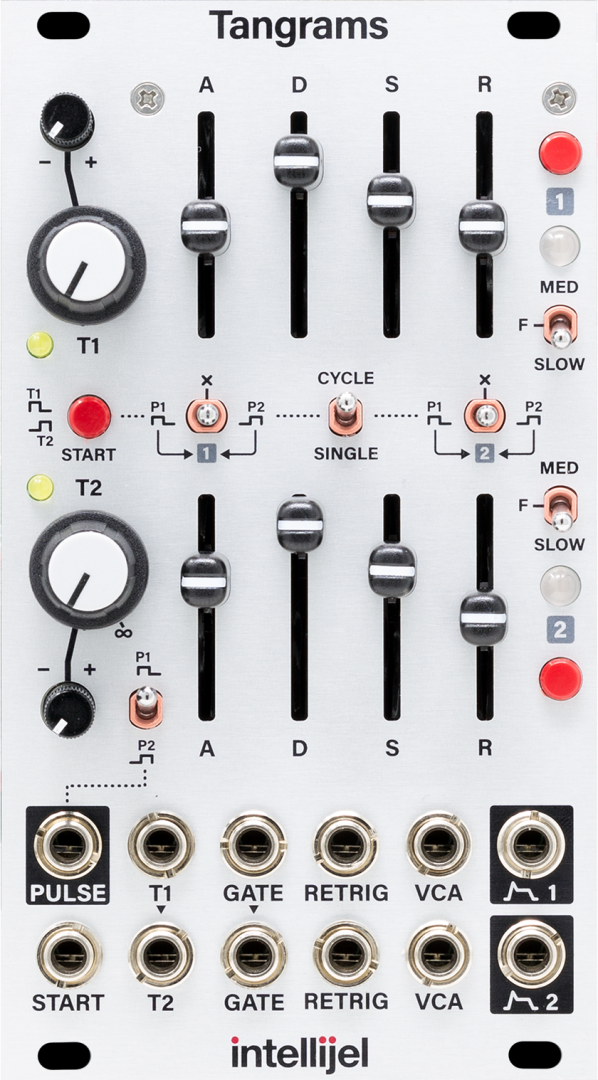
Tangrams is a dual analog core-envelope inspired by the Roland SH-101 / System 100m design with several enhancements. Taking further inspiration from trapezoidal function generators like the one on the EMS Synthi, we have added a voltage-controlled pulser circuit to link the triggering of two envelopes – allowing for delayed one-shots, cycling organic envelopes, and more. In addition, we’ve added two VCAs for level control of each envelope, or alternatively, direct injection of the signal you’d like to envelope – freeing up your other VCAs.
ADSR + VCA Features
1. Dual Analog ADSR envelopes with digital gate Pulser for trapezoid shapes
2. Pulser stages P1 and P2 can be selectively routed to trigger each ADSR via panel switches
3. Three timing ranges: (FAST: ~5 seconds, MED: ~35sec, SLOW: ~1min A/D times)
4. Retrig input (allows re-triggering of the envelope if source gate held high)
5. VCA input can be used to dynamically control the respective ADSR output level (bipolar) or to process signals to be 6. modulated in amplitude by the ADSR.
6. Manual GATE buttons for each envelope
Pulser Features
1. A pulse is made of individually controllable T1 and T2 stage lengths
2. CV control over T1 and T2 time
3. Pulser can be one-shot (SINGLE) or repeating (CYCLE)
4. PULSE output has a switch to select P1 or P2 as the source.
5. Pulser stages P1 and P2 can be selectively routed to trigger each ADSR via panel switches
6. START trigger input for starting/restarting the Pulser sequence
7. Manual GATE button to trigger the Pulser sequence
Manual
Click here to download a PDF version of the manual
MATHS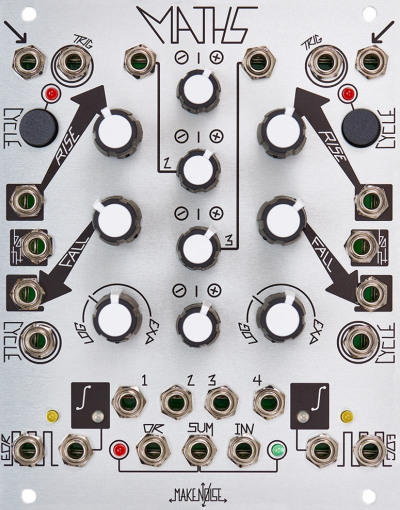
The MATHS music synthesizer module is an analog computer designed for musical purposes. MATHS builds on the tradition set into motion in the 1960s when Don Buchla adapted circuits found within analog computers for musical purposes. Buchla’s Algebraic Processor, Model 257 and 281 changed the way music synthesizers utilize control voltages. MATHS continues this great tradition – sculpting the voltages we use to sculpt sounds.
Features
1. Generate a variety of linear, logarithmic, or exponential triggered or continuous functions
2. Integrate an incoming signal
3. With no signal applied, generate a variety of linear, logarithmic, or exponential functions
4. Add, subtract and OR up to 4 signals
5. Generate analog signals from digital information (Gate / Clock)
6. Generate digital information (Gate / Clock) from analog signals
7. Delay digital (Gate / Clock) information
8. Voltage Controlled Envelope or LFO as slow as 25 minutes and as fast as 1khz
9. Apply Lag, Slew or Portamento to control voltages
10. Change the depth of modulation and modulate backwards!
11. Combine up to 4 control signals to create more complex modulations
12. Musical Events such as Ramping up or Down in Tempo, on command
13. Initiating Musical events upon sensing motion in the system
14. Musical note division and / or Flam
15. Perfect for modulating the DPO and just about anything else
Manual
Click here to download a PDF version of the manual
Optomix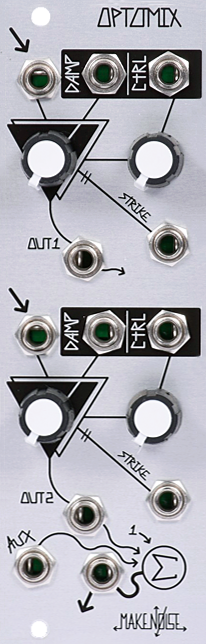
The Optomix music synthesizer module is a two channel Low Pass Gate, providing simultaneous voltage control over amplitude and frequency content of a signal. It is in essence, a Voltage Controlled Filter Amplifier (VCFA) that has an extremely organic response to control signals. The Low Pass Gate is a classic West Coast synthesis circuit. Revision 2 adds audio side-chain compression and expands CV generation and processing capabilities.
Features
1. Damp circuit updated to accept audio as well as CV allows for patching side-chain compression.
2. STRIKE INput allows use of Gate signal to trigger Low Pass Gate circuit, “plucking” or “striking” the vactrol
3. DAMP and STRIKE parameters combine to allow for easy programming of percussive sounds (sharp Attack w/ Voltage Controlled Decay)
4. Normalization of a positive offset to the Channel inputs allows for level-shifting of CV, Envelope Generator and even subtle non-symmetrical clipping of signals
5. Summing stage with an AUXiliary IN allows for chaining of multiple units creating larger mixes
6. Part of a decentralized mix console integrated throughout the system along with X-PAN, modDemix, Dynamix, and RxMx
7. Direct coupled, process audio or control signals
8. Utilizes 4 vactrols
Manual
Click here to download a PDF version of the manual
Pro Output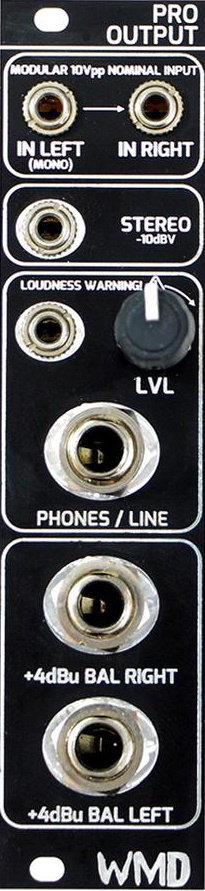
The WMD Pro Output is a simple and purpose built module to get your modular signal interfaced with professional and consumer audio gear. It also includes a very high quality headphone driver. Rail to rail opamps at the input stage allow for headroom above the typical eurorack levels of 20Vpp. The Pro Output can handle 23Vpp before clipping. Signals are attenuated down to the proper levels allowing for simple adjustment free connection to any type of device, professional or consumer. The Pro Output is DC coupled through the entire signal path, including the headphone driver. This design eliminates coupling capacitors and the distortion they can cause.
Features
1. High Headroom
2. Low Distortion / Low Noise
3. DC Coupled Signal Path
4. -10dBV Stereo Mini-jack Output
5. +4dBu Balanced Outputs
6. High Quality Headphone Amplifier
7. Loudness Limiting (Can be Disabled)
8. 3.5mm and 1/4″ Headphone Outputs
9. Completely Transparent Signal Path
Manual
Click here to download a PDF version of the manual