COJO111 Introduction to COJO I

This is the first of a two-course sequence that introduces students to essential skills of the communication and journalism discipline. Students will develop skills to communicate thoughtfully, professionally and ethically with a variety of public audiences. Essential writing and public speaking skills are paired so that students master a writing style and then convert that writing to an oral presentation, or vice versa. Students learn how to appropriately and effectively speak and write to academic, professional and citizen audiences. Students are strongly encouraged to complete this course and COJO 112 before taking any 300-or 400-level COJO courses.

COJO111 Syllabus and Meeting Times

COJO111 Introduction to COJO I

This is the first of a two-course sequence that introduces students to essential skills of the communication and journalism discipline. Students will develop skills to communicate thoughtfully, professionally and ethically with a variety of public audiences. Essential writing and public speaking skills are paired so that students master a writing style and then convert that writing to an oral presentation, or vice versa. Students learn how to appropriately and effectively speak and write to academic, professional and citizen audiences. Students are strongly encouraged to complete this course and COJO 112 before taking any 300-or 400-level COJO courses.

Meeting Times and Location Fall Semester 2019:
Monday / Wednesday 9:55 a.m. – 11:35 a.m. Room OEC 303

Download Syllabi:
COJO111 Introduction to COJO I Fall 2019

Course Weeks:
Week 1 | Week 2 | Week 3 | Week 4 | Week 5 | Week 6 | Week 7 | Week 8 | Week 9 | Week 10 | Week 11 | Week 12 | Week 13 | Week 14 | Week 15

Introduction to COJO I – Week 1

Session 1: Today let’s get into the details of the requirements for the Speech of Introduction assignment that was introduced last week.

Assignment 1: Introductory Speech (1-2 minutes)
Due: Week 2, Session 2 (5 points)

Objectives

  1. Get to know another member of the class specifically, and the rest of the class generally (and begin the process of audience analysis)
  2. To get a chance to give a short speech that demonstrates your ability to:
    a) Make good strategic choices in developing your speech for your audience
    b) Organize material effectively, with an Introduction, body and conclusion
    c) Use supporting materials (evidence) effectively
    d) Emphasize using narrative to illustrate your points of view
  3. Observe and critically evaluate how others prepare and present a speech in order to establish the foundations for more sophisticated rhetorical analysis

Logistics

  1. You will be randomly assigned a partner. If there’s an odd number of people in the class then the last group will have three people assigned.
  2. Spend time interviewing your partner in order to find out information about them that can be used in a speech of introduction. Find a compatible time and location for your interviews and document your sessions by recording audio (use a mobile phone, tablet, or laptop) of the interaction, writing notes, and transcribing the recording.
  3. Consult other sources of information to learn more about your partner, perhaps through online profiles or communicating with friends or family.
  4. Using the information gleaned from the interview and other research, prepare a 1-2 minute long speech introducing your colleague to the class. Include at least one story about the other person. Notes may be used, but deliver the speech without reading directly from any documents.

Interviewing Question Strategies

  1. As you prepare to have a conversation with your partner be aware of the questions you might ask.  Questions do not spring serendipitously from our curiosity (though they can), but can and should be a communicative event/strategy in itself.  To help you think about a “considered” question, think of continuum of question forms you can use:
    a) Closed: form a question which needs a one word or very limited answer
    b) Open: form a question that solicits longer responses. In this situation, do your best to ask open questions.
  2. Think of the types of questions you can ask during the interview: recognize that questions can be phrased in a closed to open format.
    a) A question of clarification: if they said something you didn’t understand, ask a question which will lead to understanding
    b) A question of extension: if they said something that you understood but would like to hear more about, this type of question should lead to an extension of their original comments;
    c) Question seeking new information: this is a “left field” question where you may ask them about any topic which was not addressed in the course of their answers thus far.
  1. Prepare a list of starter questions, though don’t be confined by these – they are starters for the conversation!
    a) Consider the “information” you want from your partner (often fairly closed questions: “where did you go to high school?”)
    b) Consider the “opinions” you want to encourage from your partner (more open questions: “how do you like St. Thomas so far?”)
    c) Consider the order in which you want to develop your line of questioning: what will you start with and where will your questioning take you (home and family, educational and professional plans, individual interests and activities, opinions on current issues)
    d) Create a device for taking notes

Preparing the speech

  1. Prepare the opening: what will you say first to begin your speech?
  2. How will you “introduce” your subject?
  3. How will you cluster the content of your speech so it is easy to follow, understand and remember?
  4. How will you end your speech – what will you say last?

Evaluating the speech
You will be evaluated on how effectively you:

  1. Meet the requirements of the assignment
  2. Present the speech within the context of the situation
  3. Effectively engage the audience and deliver the message

Relevant Reading
Read Pages 1–19 of The Speaker’s Compact Handbook (Fifth Edition)

Female education advocate and youngest ever Nobel Prize laureate, Malala Yousafzai, interviewed by Jon Stewart in 2013.

KHUM-FM Program director, music director, and mid-day host Mike Dronkers on How to Interview “Almost” Anyone.

1. Do the research!
2. Follow up on their answers
3. Relevant Ice Breakers
4. Listen!
5. Dead air chicken
6. Bored people are boring / Interested people are interesting
7. Don’t forget to shut up

Session 2: Today we will be presenting your speeches of introduction. You and your partner will sit at the front of the class and introduce each other. Please remember to keep it quick (1-2 minutes).

Introduction to COJO I – Week 2

Session 1: Today we will discuss the requirements and materials for the Narrative Speech assignment.

Assignment 2: Narrative Speech (3-5 minutes)
Due: Week 3, Session 1 (40 points)

Description
Write and perform a 3 to 5 minute narrative speech based on one of your own own personal experiences that you are comfortable sharing with the class. This assignment gives you a chance to practice preparing and presenting a speech and to give and receive feedback from the audience. You will get feedback on your speech from the instructor and one of your classmates.

Overview
The narrative speech is essentially a speech that tells a story. Narrative speeches often deal with a personal experience. We hear this kind of speech from athletes, missionaries, and business leaders, who often have interesting personal stories to tell. For this assignment, you will describe a personal experience.

Requirements
1. Prepare a 3- to 5-minute speech, outlining your major points on note cards or half-sheets of notebook paper.

2. You will describe a vivid experience that has a moral or a lesson, something that touched you intensely, or was funny, interesting, or transformative.

3. Study narrative speaking styles by listening to one or more speeches in a similar format to our in-class example from the Moth Radio Hour

4. Perform the speech to the class on the due date and give feedback to a minimum of one of your classmates.

5. Submit your notes and an outline of your speech as a PDF on Canvas before class on the due date.

Required Reading
The Speaker’s Compact Handbook (Pages 19–32)

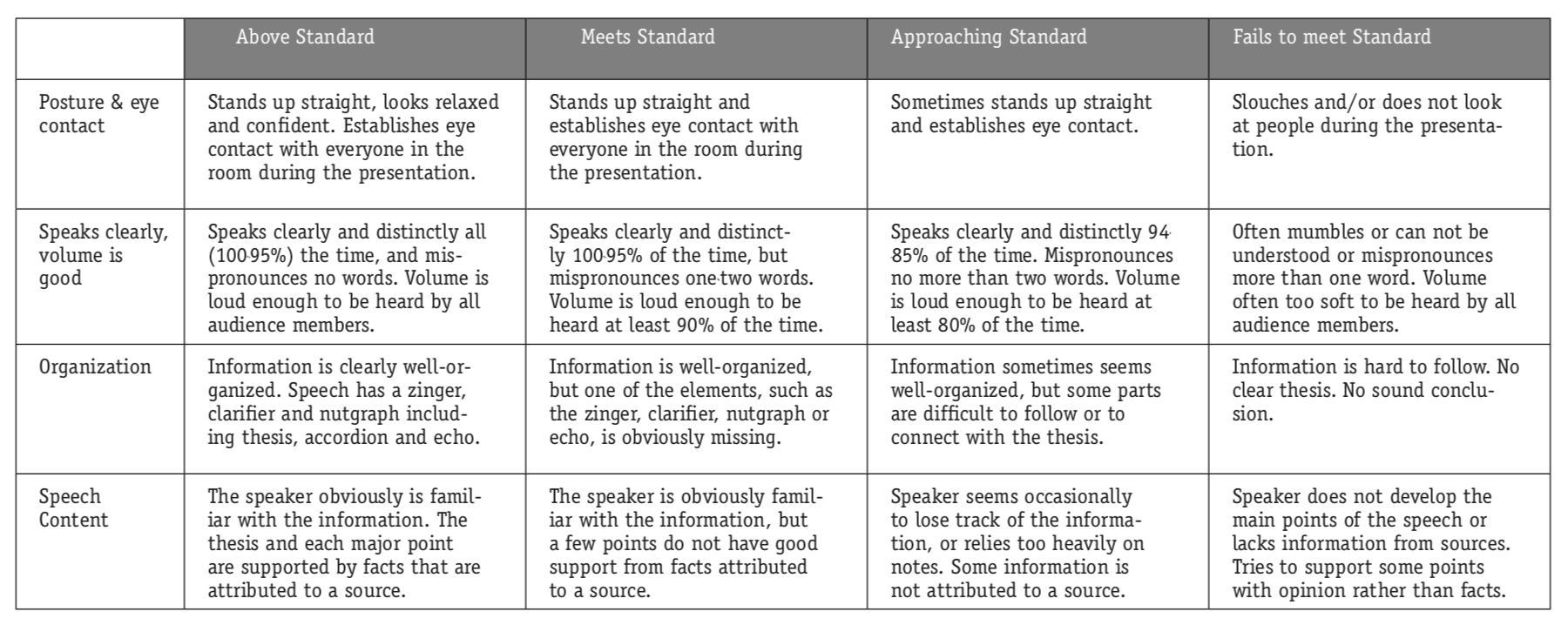
Rubric

Above Standard

Meets Standard

Approaching Standard

Fails to meet Standard

Time-Limit

Presentation is 3–5 minutes long.

Presentation is under 3 minutes or over 6 minutes.

Presentation is under 2 minutes long or over 7 minutes.

Presentation is under 1 minute or over 8 minutes long.

Posture & Eye Contact

Stands up straight, looks relaxed and confident. Establishes eye contact with everyone in the room during the presentation.

Stands up straight and establishes eye contact with everyone in the room during the presentation.

Sometimes stands up straight and establishes eye contact.

Slouches or does not look at people during the presentation.

Speaks Clearly

Speaks clearly and distinctly all (100-‐95%) the time, and mispronounces no words.

Speaks clearly and distinctly all (100-‐95%) the time, but mispronounces one-‐two words.

Speaks clearly and distinctly most (94-‐85%) of the time. Mispronounces no more than two words.

Often mumbles or can not be understood or mispronounces more than one word.

Volume

Volume is loud enough to be heard by all audience members throughout the presentation.

Volume is loud enough to be heard by all audience members at least 90% of the time.

Volume is loud enough to be heard by all audience members at least 80% of the time.

Volume often too soft to be heard by all audience members.

Speech Content

Speech content is concise, creative, and logically organized. The introduction, body, and conclusion are fully developed.

Speech content is creative and organized. The introduction, body, and conclusion are strong.

Speech content is organized. The introduction, body, and conclusion are present.

Speech lacks organization. The introduction, body, and conclusion are present, but not fully developed.

Session 2: Today you will be taking the GPS Pre-Test on Canvas. There will be no preparation or review for this quiz. This is a practice test and your results will not impact your final grade. The goal is to get an idea of what you already know about English grammar and punctuation. A similar test for credit will be given in Week 14 after all the study guides, assignments, and readings have been completed.

Following the test we will look at the Poynter Language Primer as described in the syllabus. This test will be taken online and offers two attempts to get a passing grade of 80%.

Introduction to COJO I – Week 3

Session 1:Today you will be performing your Narrative Speech. It is possible that we will not be able to finish all the speeches today. In that case the remaining speeches will be performed on Session 2.

Session 2: Today, after any remaining speeches are performed, we will be discussing the requirements for the Informative Speech.

Assignment 3: Informative Speech (3-5 minutes)
Due: Week 4, Session 2 (40 points)
Outline Format Worksheet

Description
The purpose of an informative speech is to share reliable factual information that you have acquired through research. It is not intended to promote a policy or opinion; rather, it seeks to provide a foundation for people to better understand a topic that relates to them. This project offers an opportunity to practice your research, writing, organizing and speaking skills. This is a type of speaking used by professionals. You will: thoroughly research and understand a topic; create a clearly organized speech; practice an enthusiastic, dynamic style of delivery; and seek to provide interesting and useful information to the audience.

Requirements
1. Length: 3-5 minutes. An outline is required. Note cards must be used.

2. Electronic sources must be authoritative and credible.

3. Use a minimum of three sources, including one “expert” interview from a print or online source.

4. Turn in a speech outline with a Works Cited Page, MLA format, on the day of the speech as a PDF on Canvas.

Required Reading
The Speaker’s Compact Handbook (Pages 33–74)

Rubric:

Introduction to COJO I – Week 4

Session 1: Today we will be covering more materials that support the Informative Speech assignment. We will start by looking at the reading in the Speaker’s Compact Handbook and then move on to a discussion about your topics and how you might narrow the scope in order to meet the time constraints.

Informative Speaking Guidelines (PDF)

Session 2: Today we will work in groups looking at your outline rough drafts for the Informative Speech. Please compose your outlines using Google Docs so you can share the document with me and your classmates. Please use the Informative Speech Outline Format Guide that I handed out in class last week.

The following infographic illustrates a set of search techniques that drastically help narrow your search results and get you the information that you’re after while doing research online.

Get More Out Of Google

Introduction to COJO I – Week 5

Session 1: Today you will be presenting your informative speeches. If you plan on having visual aids, please make sure that you create them as a Google Slides document and share it with the email address that I gave everyone last week (check Canvas for details).

Also, tonight is the COJO Career Event Panel, October 8 from 5-7pm. Please be there and I will be taking attendance.

Session 2: If we run out of time for the Informative Speeches then today we finish up. After we will be discussing the requirements for the Professional Email writing assignment. Todays presentation will provide you with a set of criteria to help you write your professional email message.

Assignment 4: Professional Email
Due: Week 6, Session 2 (10 points)

Description
Email can serve many purposes, from friendly notes to job applications. Messages differ in formality according to the audience and desired outcome. Emails for advertising clog inboxes, preventing some emails from reaching the audience. It is a challenge is to make emails stand apart from “spam,” and to grab and hold the attention of the reader.

Requirements
Write a professional-quality email using ONE of the following prompts:
1. You are president of the Public Relations Student Society of America chapter at St. Thomas. You want to invite Anastasia Lopez, Vice President of Social Media, at PadillaCRT to speak to your group about the role of social media in public relations. Your regular weekly meetings are at 7 p.m. Thursdays, and you hope to have her visit on one of the first four Thursdays in October. You have 25 members; your adviser is Professor Xiaowen Guan.
2. You want to apply for an internship in social media with Thrivent Financial in Roseville. The job description and contact information are on the next page. You have your resume ready and will include it as an attachment.
3. You are writing a story for TommieMedia on the relationship between the university and area merchants. Specifically, three nearby restaurants and one convenience story have suffered incidents of vandalism. Two merchants have been quoted as saying that St. Thomas students are to blame. You want to meet face to face with Amy Gage, neighborhood relations manager for the university. You want to ask about:
a. the current state of relations between the university and neighborhood merchants.
b. how many complaints the university has received about student behavior from merchants specifically in recent years.
c. the nature of those complaints, specifically, how many have included vandalism.
d. steps the university has taken to work with merchants on maintaining good relations with the university.
4. Type of your email in a word document. Name it email-yourlastname.docx
5. BE SURE TO INCLUDE A SUBJECT LINE, OPENING AND CLOSING.
6. Upload it to Canvas by 11:59pm on Week 6, Session 2.

Introduction to COJO I – Week 6


SPCA Condom Campaign: The world’s first pet condom

Session 2: Today we will be discussing the Web Based Informational Campaign requirements. Afterward I will begin demonstrating the the techniques for creating the Web Based Informational Campaign.

Required Reading: News Writing from Prof. Michael O’Donnell

Assignment 4: Web-based Informational Campaign and Tweet
Due: Week 10, Session 1 (40 points)

Description
An informational campaign is essentially a news story designed to persuade people to act. The content of the story should be 500 words in length (give or take 25 words). Convey the information to your audience in a factual manner. Good news stories are concise and well organized. They use crisp, active language, and flow well. Effective news stories also draw the reader in by including at least one news value, such as: timeliness, proximity, significance/impact, prominence, conflict, novelty, audience or drama.

Include a five to seven-word headline at the top of your informational campaign. The headline and the first paragraph (referred to as the “lede”) are especially important in order to quickly interest your audience in the campaign. Your lede should answer who, what, when and where. It should be 25 to 50 words in length. Do not write a question lede! Your story should flow from there. Remember to include the why and how – as early as the second graph. A good rule-of-thumb is one idea per paragraph. Citations/attribution of your sources is crucial.

Objectives
The purpose of this assignment is to write and design a web based informational campaign to persuade us that:
1) there is a significant and harmful problem that merits consideration, and that,
2) through the implementation of a social, behavioral, or policy change solution the problem will be solved and/or result in advantages.
3) The website will used to give a 5–7 minute persuasive presentation and contain the usual components of an informational campaign.

Web-based Campaign
The website will contain the following elements that are easily identified by the listeners:
1. The topic/resolution is clear to the audience – we need to know what you’re asking us to consider.
2. The components of the introduction are clear and compelling: opening attention-getter, identification of the topic and the thesis statement.
3. The problem is structured to emphasize one or more main points, and contain evidence that proves the significance and harm of the problem.
4. The solution is presented in a clear manner, with emphasis on the listeners’ understanding of the social, behavioral, or policy change being proposed.
5. The website contains an “argumentation” section that has a plan-meet-need argument and/or a comparative advantages argument. Other pre-emptive arguments, such as workability, cost, disadvantages and/or desirability, may be included where appropriate and necessary.
6. The websites will contain a variety of evidence forms and at least three different sources cited.
7. Emotional appeals may be used where appropriate and if necessary.

Logistics
1. Build the website using the templates provided by the instructor. Follow along with the demos produced in class. Videos of the in-class demos will be provided so that you can review them outside of class.
2. Use a color scheme, images, typesetting, and layout that supports your campaign.
3. Create a folder that contains all the files necessary and then archive the folder using .zip format and turn it into Canvas before the due date.
4. Your website will be used as the topic and slides for your presentation.
5. Write a Tweet this is 280 characters or less in length that summarizes your campaign and includes a link to your site (this links will be provided in an announcement on Canvas).
6. The Web Info Campaign will be graded on the basis of how well it meets the requirements for the assignment and makes use of the strategies outlined in the reading.

Session 2: Today we will have the first of several demos regarding the Web Based Informational Campaign project. In today’s demo we will use the Atom text editor to create an HTML (Hypertext Markup Language) document. This document will include a title (shows up in the tab), image, headline, paragraph, unordered list, and a link. The demonstration will be recorded and posted on Canvas under Pages. Here’s some resources to get you started.

Download the Atom Text Editor
Getting Started with HTML

Introduction to COJO I – Week 7

Session 1: Today we will continue demonstrations for the Web Based Informational Campaign project. This will be in the form of a web design workshop. I will demonstrate a few techniques and help you implement techniques on your own projects.

Required Reading: Tweets, Titles, and Headlines

Session 2: Today we will continue to work on the Web-based Informational Campaign and Tweet project, but we will also discuss the requirements for the Digital Audio News Story.

Project 2: Digital Audio News Story
Due: Session 1, Week 10 (40 points)

Description:
The Digital Audio News Story involves layering audio into a comprehensive story that is written for the ear. The length music at between 90 seconds and 3 minutes. Insure that your audio layers are mixed well and and don’t sonically interfere with each other. Your will be a news story, like what you might hear on a podcast or radio broadcast. Include ambient audio that relates to the topic and interview at least one person for commentary.

Requirements:
1. Timing (when and how sounds enter and exit during the piece) is an important factor. Try and space sounds naturally. Allow the listener to form a mental picture of what they’re hearing.

2. Use volume and panning to mix and spatialize sound layers. Record your narrative in a quiet space and make sure your recording levels are loud enough to prevent noise, but not so loud that clipping occurs.

3. The length should be at between 90 seconds and 3 minutes. Time your story carefully to allow for opening statements, background audio, and interviewee commentary.

4. Record the audio using your phone and/or laptop computer. Transfer audio recorded on your phone to your computer to be edited and mixed using Audacity.

5. Upload the edited and mixed audio file to Canvas before class starts on Week 10, Session 1 when we will be presenting your projects for in-class critiques. Please include 2-3 paragraph comment explaining your story, production, and post-production processes on Canvas.

Points Breakdown:
15 points are awarded for the quality and arrangement of the recorded tracks.
20 points are awarded for the creative content, style, and tone of the piece.
5 points are awarded for sharing your piece during the in-class presentations.

Clipping is a form of waveform distortion that occurs when an amplifier is overdriven and attempts to deliver an output voltage or current beyond its maximum capability.

— Wikipedia


Introduction to COJO I – Week 9

Session 1: Today we will begin by discussing the use of visual aids in presentations. I’ll start by showing you the slides from my most recent presentation and explaining how I put them together. Afterward there will be time to get some feedback and ask questions about your Web-based Informational Campaigns.

Session 2: Today we will discuss the requirements and reading for the Public Communication Response writing assignment. This projects will get you involved in civic engagement in the “post-truth era.” One thing that is very important is that we know the difference between reliable news sources, satire, and fake-news.

Public Communication Response
Due: Session 2, Week 12 (20 points)

Description: Write a 400-500 word paper as a response to the reading, Read All About It: The Politicization of “Fake News” on Twitter. This will be an example of Civic Engagement in the Post-truth Era. Your paper will describe an example from the news that you believe illustrates how a story that is false, maybe obviously false, has had implications for our political system. Use concepts from the study to discuss this story and its fallout. Be sure to cite your source for your news item and the reading.

Reading: Brummette, J., Distaso, M., Vafeiadis, M., & Messner, M. (2018). Read All About It: The Politicization of “Fake News” on Twitter. Journalism & Mass Communication Quarterly, 95(2), 497-517. Available under the Files section on Canvas.

Prompt: This academic study provides a thorough discussion of the phenomenon of “fake news” and investigates how social media is involved in creating and propagating fake news.  Here is the abstract from the article:

Due to the importance of word choice in political discourse, this study explored the use of the term “fake news.” Using a social network analysis, content analysis, and cluster analysis, political characteristics of online networks that formed around discussions of “fake news” were examined. This study found that “fake news” is a politicized term where conversations overshadowed logical and important discussions of the term. Findings also revealed that social media users from opposing political parties communicate in homophilous environments and use “fake news” to disparage the opposition and condemn real information disseminated by the opposition party members.

Homophilous is defined as the tendency of individuals to associate and bond with similar others, as in the proverb “birds of a feather flock together.” It’s a key term in understanding how fake news takes on life despite countervailing information.

  1. Read the first six pages down to the heading “Method,” then skip down to the heading “Discussion” on page 509 and read on from there.
  2. In your response paper of 400-500 words:
    • Describe an example from the news that you believe illustrates how a story that is false, maybe obviously false, has had implications for our political system. Use concepts from the study to discuss this story and its fallout. Be sure to cite your source for your news item.
    • Discuss the role of social media  in the “market place of ideas.” DO NOT simply state your opinion. Find an example of how social media has played a part in helping to form public opinion and even affect the actions of the state. Be sure to cite your source or sources.

Formatting your work: Put your name, the class (COJO 111) and section, and the date in the upper left corner of your first page. Double-space your work. Follow MLA style in citing your sources.

Grading criteria:

  1. Engagement with the text: How thoroughly and effectively are the concepts from the reading used as tools of analysis?
  2. Quality of research: Only one or two sources are necessary for this assignment. Is that source reliable? Does it provide an adequate depth of knowledge?
  3. Accuracy: Remember that accuracy is all-important. Double check your facts, use your spell checker and do your best with grammar and punctuation.

Key terms

cluster analysis
content analysis
fake news
homophily
marketplace of ideas
pluralism
post-truth
social network analysis
truthiness (coined by Stephen Colbert)

Rubric

Response paper
Response paper 2
Criteria Ratings Pts

This criterion is linked to a Learning OutcomeEngagement with the text

How thoroughly and effectively are the concepts from the reading used as tools of analysis?

7.0 to >0.0 pts

Your score

0.0 pts

No Marks
7.0 pts

This criterion is linked to a Learning OutcomeQuality of research

Only one source besides the assigned reading is necessary for this assignment. Is the source reliable? Does it provide an adequate depth of knowledge?

7.0 to >0.0 pts

Your score

0.0 pts

No Marks
7.0 pts

This criterion is linked to a Learning OutcomeAccuracy

Facts are correct and cited to a reliable source. Grammar, punctuation and spelling are correct.

6.0 to >0.0 pts

Your score

0.0 pts

No Marks
6.0 pts
Total Points: 20.0

Introduction to COJO I – Week 10

Session 1: Today your Web-based Information Campaigns are due. We will spend class time making sure that each of you have your documents organized and submitted properly before the presentations on Session 2. Once your documents have been submitted I will make them available via the Internet and provide you with a link.

Session 2: Today you will be presenting your Web-based Informational Campaigns in class. Use your web site as a visual aid to explain your topic and describe your research.

Introduction to COJO I – Week 11


Infective Heredity from Radiolab

Session 1: The Digital Audio News Story is due one week from today. After we finish the remaining Web-based Info Campaign presentations we will have studio time available to help with your Digital Audio News Stories.


Video: 5 Ways to Spot Fake News downloaded from PBS LearningMedia. © 2017 WGBH Educational Foundation. All Rights Reserved. Courtesy of Common Sense Education. Project funded by: WGBH

Session 2: During today’s class let’s have a discussion regarding the reading for the Public Communication Response paper (due one week from today).

Introduction to COJO I – Week 12

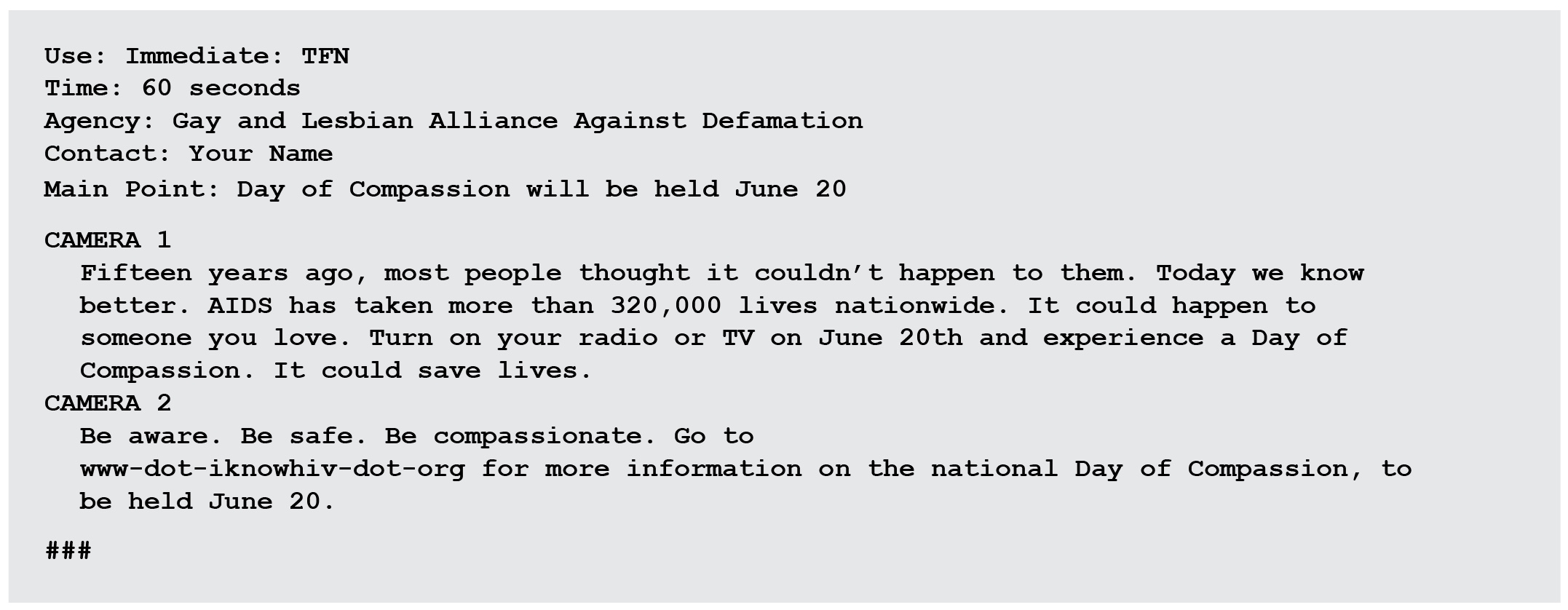
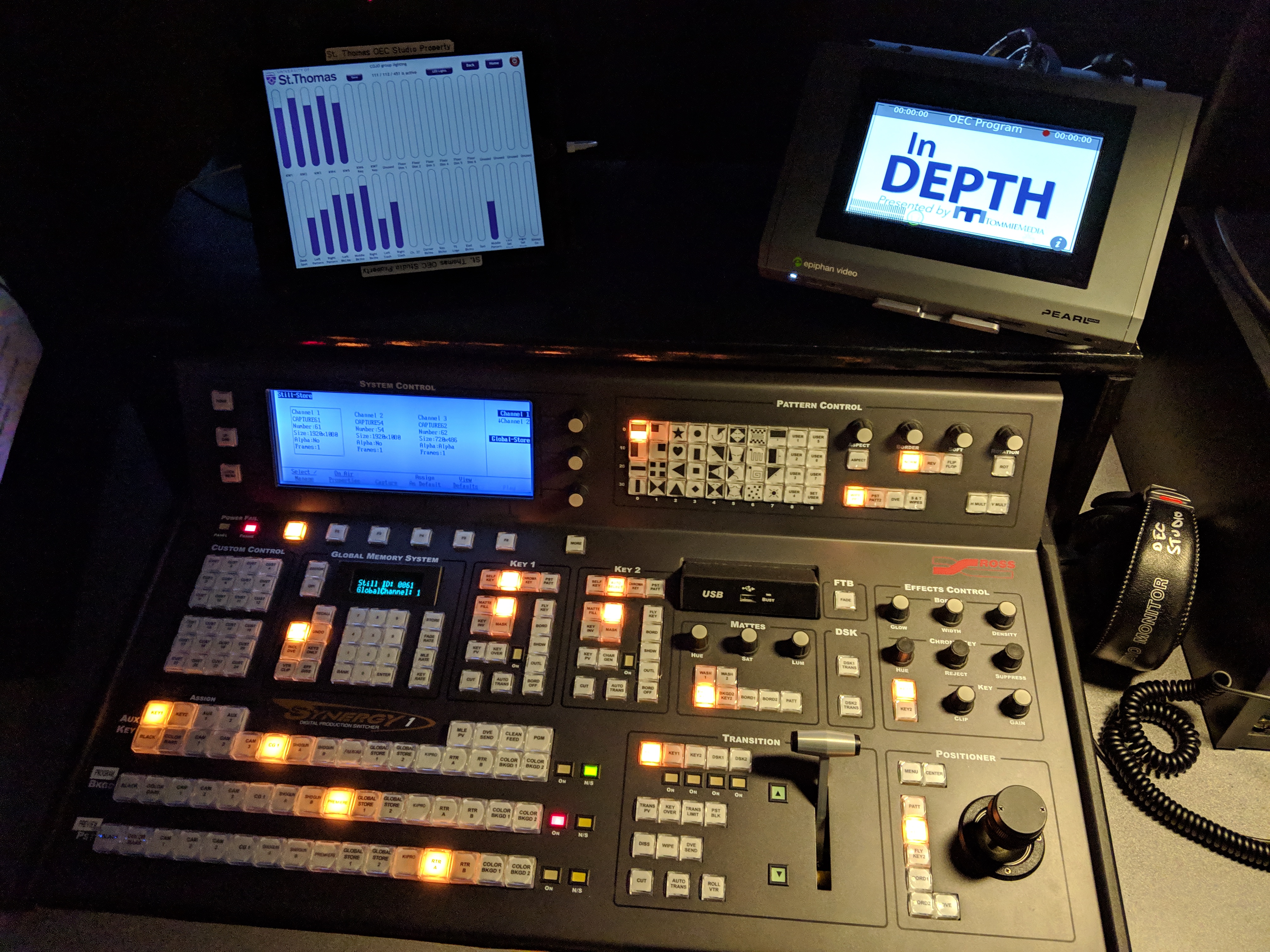
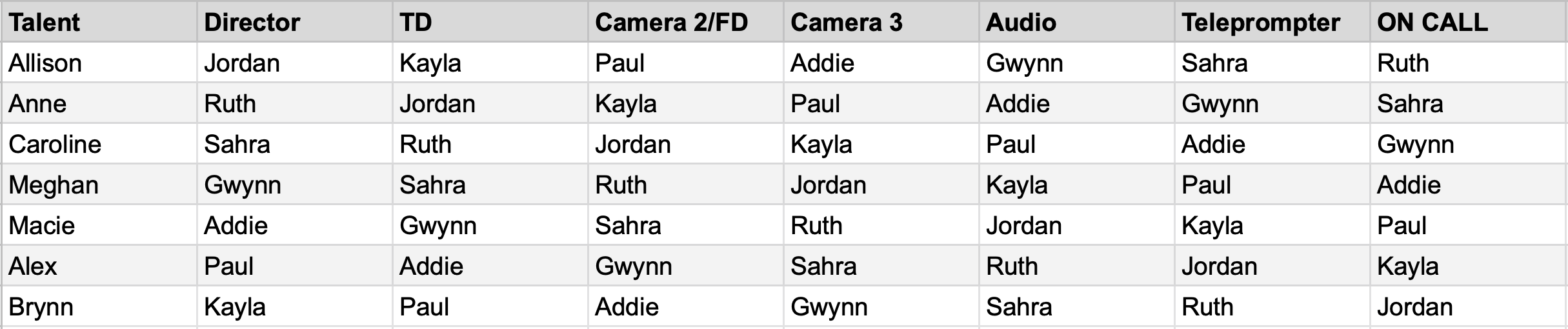
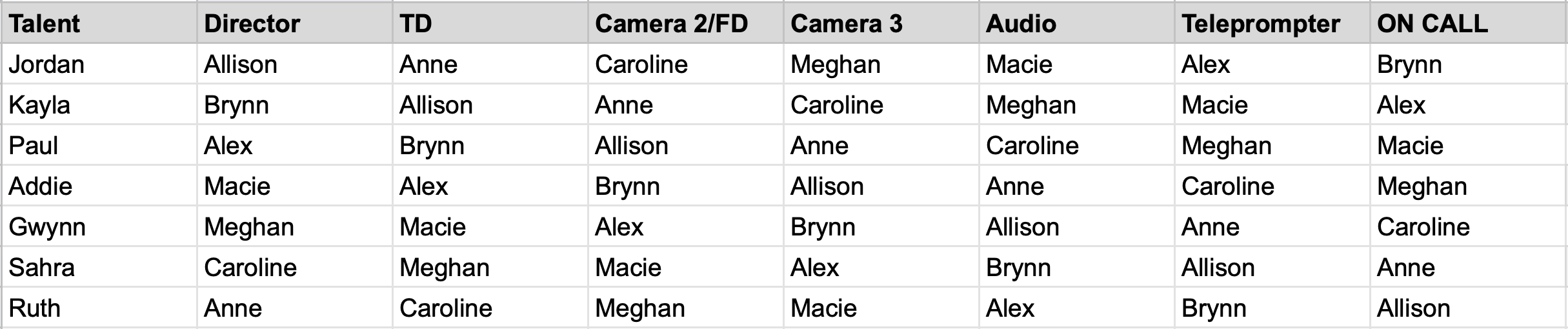
Session 1: Today we will begin our discussions about the Public Service Announcement project. Ask yourself what do you want your audience to know? What do they need to know? How do you get your message across? Is the message timely, relevant, helpful, engaging? All of these questions should be considered when writing a public service announcement. Famous PSAs include Smokey the Bear, “This is Your Brain on Drugs”, and the Incredible Crash Test Dummies.

Assignment #8: Public Service Announcement:
Communicating for a cause

Due: Session 2, Week 12 (20 points)

Rubric

PSA Announcement
Criteria Ratings Pts

This criterion is linked to a Learning Outcome On-camera presence

10.0 to >9.0 pts

Above standard
Sits up straight while maintaining a relaxed appearance. Looks natural while reading the teleprompter. Doesn’t sway or fidget.

9.0 to >6.0 pts

Meets standard
Sits up straight but displays some tension. Obvious in reading the teleprompter. Minor fidgeting or swaying.

6.0 to >4.0 pts

Sometimes meets standard
Slouches slightly or leans to one side. Has problems reading the teleprompter. Some swaying and fidgeting.

4.0 to >0.0 pts

Fails to meet Standard
Poor posture; slouches in chair. Has obvious problems reading the teleprompter. Fidgets or sways noticeably.

0.0 pts

No Marks
10.0 pts

This criterion is linked to a Learning Outcome Volume and diction

10.0 to >8.0 pts

Above standard
Reads clearly and at an understandable pace. No mispronounced words. Is ready to begin when cued. Stays in place until camera stops rolling.

8.0 to >6.0 pts

Meets standard
Reads clearly and at a comfortable pace. Some mispronounced words or stumbling over the words. Is ready to read when cued and stays in place until the camera stops rolling.

6.0 to >4.0 pts

Sometimes meets standard
Reads clearly with some loss of volume. Minor speed ups or slowing down in pace. A few mispronounced words or stumbling over the script. Not ready to go when cued or quick to look away or take other action before the camera stops rolling.

4.0 to >0.0 pts

Fails to meet Standard
Stumbles over words to the point where unfamiliarity with the script is obvious. Mispronounces several words. Loses volume, speeds up and slow downs, or reads too fast. Unprepared when cued.

0.0 pts

No Marks
10.0 pts

This criterion is linked to a Learning Outcome PSA content

10.0 to >8.0 pts

Above standard
Content is concise, creative, logically organized. Includes a good zinger, succinct message and a good closing, such as a call to action.

8.0 to >6.0 pts

Meets standard
Content is concise, and organized. Includes a zinger, succinct message and a good closing, such as a call to action.

6.0 to >4.0 pts

Sometimes meets standard
Content is concise, creative, organized but does not have a clear message. Includes a zinger, message and a closing, such as a call to action.

4.0 to >0.0 pts

Fails to meet Standard
Content is disorganized. Does not include a zinger, or a good closing, such as a call to action.

0.0 pts

No Marks
10.0 pts

This criterion is linked to a Learning Outcome Length

5.0 to >4.0 pts

Above standard
One minute in length, within five seconds.

4.0 to >3.0 pts

Meets standard
50–55 seconds or 65–70 seconds

3.0 to >2.0 pts

Sometimes meets standard
45–50 seconds or 110–115 seconds.

2.0 to >0.0 pts

Fails to meet Standard
Less than 45 seconds or more than 75 seconds.

0.0 pts

No Marks
5.0 pts

This criterion is linked to a Learning Outcome Script

5.0 to >3.0 pts

Full Marks
Script turned in on time in proper form. Camera move clearly noted.

3.0 to >2.0 pts

Approaches standard
Script turned in on time, but lacks neatness or does not have camera move properly noted.

2.0 to >0.0 pts

Fails to meet Standard
Script not turned in on time; lacks neatness; camera movement not noted properly.

0.0 pts

No Marks
5.0 pts
Total Points: 40.0
Relevant Resources:

Session 2: After listening to your Digital Audio News stories we will continue discussions regarding the PSA assignment.

Introduction to COJO I – Week 14

Session 1: Today we will record the second round of PSAs.

Session 2: Today we will take the final version of the GPS Post-Test. Afterward all post-production and editing of your PSAs will be handled. You will be required to decide on alternate takes and have assets available for any OTS (over the shoulder) graphics.