All posts by keston

Introduction to COJO II – Week 4

Session 1: Today we will discuss the requirements for the Rhetorical Critical Analysis project. Following the discussion we will have an in-class exercise listening to Tears Dry on Their Own by Amy Winehouse.

Assignment 3: RHETORICAL CRITICAL ANALYSIS
Due: Week 8, Session 2 (8 points)

Objectives
This assignment should help us to accomplish the following objectives:

1. Provide you with the opportunity to evaluate a text from a critical perspective.
2. Increase your abilities as a rhetorical critic.
3. Provide you with a comparative base from which to assess your own ability to engage in rhetorical communication.
4. Increase your ability as a writer of criticism.

Logistics
Music is a universal form of communication. In many way music can communicate things that are much more difficult with words. When music and lyrics are combined into song the human condition is never better understood. Choose a song that has lyrical content that can be criticized and analyzed in a rhetorical fashion. Look for metaphors and paradoxes. Use Aristotle’s modes of persuasion (ethos, pathos, and logos) in your analysis.

Ethos (sometimes called an appeal to ethics is used as a means of convincing an audience via the authority or credibility of the persuader, be it a notable or experienced figure in the field or even a popular celebrity. Pathos (appeal to emotion) is a way of convincing an audience of an argument by creating an emotional response to an impassioned plea or a convincing story. Logos (appeal to logic) is a way of persuading an audience with reason, using facts and figures.

1. Find a significant piece of oral rhetoric (a song) that you would like to analyze.
2. Gather information about the rhetorical situation of the song:
Who is the artist, why are they in this situation, what is their credibility (ethos) with the audience and why?
What is the controlling exigency (ethos) in the situation? How is the exigency perceived by the artist and the audience?
What constraints might there be in the situation? What is the occasion? How do you imagine the physical space?
Who is the audience? Who among the listeners is a member of the “rhetorical audience?”

Much of this requires you to investigate the historical context and circumstances of the song. What in the artists past may have led them to write what they did?

3. Review the song from a critical position. Try to identify the strategies the artist employs in the lyrics. Note where you find the most important elements of the piece. Among other things, look for:

The introduction – what was done and how was it received?
The organization – was it clear or confusing? did it follow a pattern? did it affect the message the audience might remember or respond to, etc.?
The evidence – what forms did it take, how well was it connected with an argument or persuasive appeal, was it varied, interesting and impactful?
The language used: was it poetic, functional, metaphoric, etc.?
The conclusion – how did it end?
What were the strengths and weaknesses of the speaker’s delivery?

4. Prepare your critical analysis, selecting from #2 and #3 above, those central elements that you think led to the level of success reached by the artist in their piece. Include a YouTube link to the song and the song lyrics with your paper. Write the review in 5–6 pages (not including the lyrics page) and provide the reader with a unique and insightful understanding of how this rhetorical message worked in this situation. Are there any lessons we can learn from this artist and their music? How effective (or ineffective) were they in this situation?

5. Turn in your review through Canvas before class on the due date.

6. These papers will be graded on the basis of how well they:
Meet the requirements for the assignment
Demonstrate an understanding of rhetoric and criticism
Reflect your level of insight about speech-making
Write the review with clarity, accuracy, and engagement

Session 2: Today we will be discussing the Web Based Informational Campaign requirements. I would also like to get the artists and song titles for your Rhetorical Critical Analysis. If time permits I will being demonstrating the the techniques for creating the Web Based Informational Campaign.

Assignment 4: WEB BASED INFORMATION CAMPAIGN
Due: Week 11, Session 1 (10 points)

Objectives
The purpose of this assignment is to write and design a web based informational campaign to persuade us that:
1) there is a significant and harmful problem that merits consideration, and that,
2) through the implementation of a policy change solution the problem will be solved and/or result in advantages.

The website will be presented with a 6–8 minute persuasive presentation and contain the usual components of a good informational campaign. The proposed policy change will be structured in the form of a resolution; resolved, that the organization will engage in a policy.

The website will contain the following elements that are easily identified by the listeners:
1. The topic/resolution is clear to the audience – we need to know what you’re asking us to consider.
2. The components of the introduction are clear and compelling: opening attention-getter, identification of the topic and the thesis statement.
3. The problem is structured to emphasize one or more main points, and contain evidence that proves the significance and harm of the problem.
4. The solution is presented in a clear manner, with emphasis on the listeners’ understanding of the policy change being proposed.
5. The website contains an “argumentation” section that has a plan-meet-need argument and/or a comparative advantages argument. Other pre-emptive arguments, such as workability, cost, disadvantages and/or desirability, may be included where appropriate and necessary.
6. The websites will contain a variety of evidence forms and at least three different sources cited.
7. Emotional appeals may be used where appropriate and if necessary.

Logistics
1. Build the website using the templates provided by the instructor. Follow along with the demos produced in class. Videos of the in-class demos will be provided so that you can review them outside of class.
2. Use a color scheme, images, typesetting, and layout that supports your campaign.
3. Create a folder that contains all the files necessary and then archive the folder using .zip format and turn it into Canvas before the due date.
4. Your website will be used as the topic and slides for your Persuasive Speech.
5. The Web Info Campaign will be graded on the basis of how well it meets the requirements for the assignment and makes use of the strategies for persuasion outlined in the reading.

Reading: A Sharp Pencil Works Best PDF (before 3/7)
Introduction to COJO II – Week 5

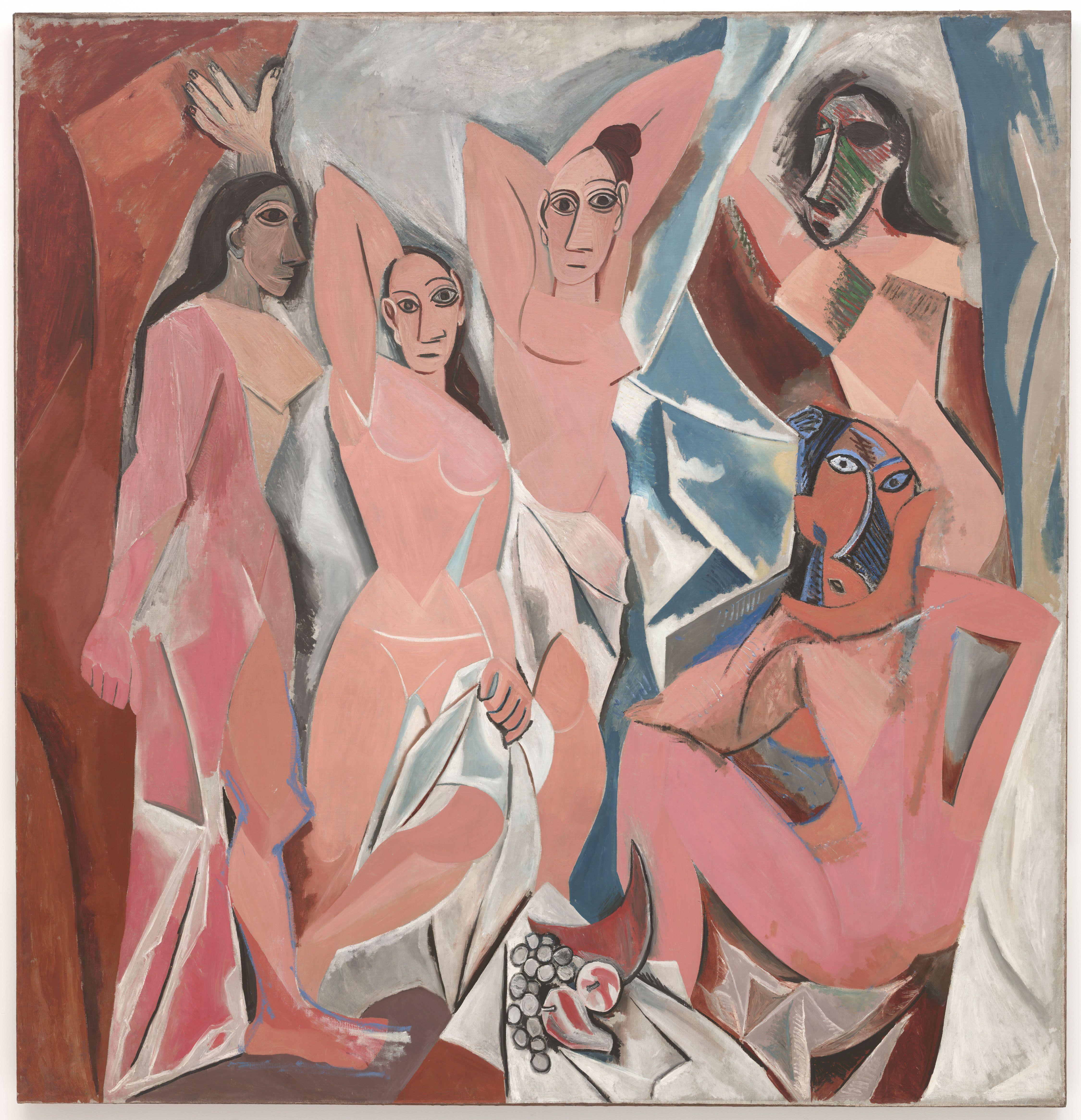
Les Demoiselles d’Avignon (1907), Museum of Modern Art, New York

Session 1: Today your opinion pieces are due. Please do not forget to have your abstract ready for in class discussions.

An abstract is a brief summary of a research article, thesis, review, conference proceeding, or any in-depth analysis of a particular subject and is often used to help the reader quickly ascertain the paper’s purpose. en.wikipedia.org/wiki/Abstract_(summary)

Session 2: Today we will have the first of several demos regarding the Web Based Informational Campaign project. In today’s demo we will use the Atom text editor to create an HTML (Hypertext Markup Language). This document will include a title (shows up in the tab), image, headline, paragraph, unordered list, and a link. The demonstration will be recorded and posted on Canvas under Pages. Here’s some resources to get you started.

Download the Atom Text Editor
Getting Started with HTML

Introduction to COJO II – Week 6

Session 1: Today Concept Summary #2 is due. As a prompt for our discussion let’s take a look at the Represent.US campaign. This campaign include a website and video and uses many of the strategies described in A Sharp Pencil Works Best. If time permits, after the discussion we will have another demonstration for the Web Based Informational Campaign project.

Session 2: Today we will continue demonstrations for the Web Based Informational Campaign project. This will be in the form of a web design workshop. I will demonstrate a few techniques, help you implement the technique on your own projects.

Reading: The Critical Perspective (before next class)

Introduction to COJO II – Week 7

Session 1: Today we will continue our demonstrations for the Web Based Informational Campaign. Following the demo I will allow for studio time to implement the techniques shown in class. We will also discuss the requirement for the accompanying Persuasive Speech.

PERSUASIVE SPEECH ASSIGNMENT
Week 11, Session 2 Before Class (10 points)

DESCRIPTION
The purpose of this assignment is to present a speech designed to persuade us that there is a significant and harmful problem that merits consideration, and that, through the implementation of a policy change solution the problem will be solved and/or result in solutions or advantages. NOTE: Use your Web Based Informational Campaign as the slideshow for your presentation. The speech should be presented in four to six minutes and should contain the usual components of a good speech.

LOGISTICS / REQUIREMENTS
The speech should contain the following elements that should be easily identified by the listeners:

1) Make sure the topic is clear to the audience.
2) Use clear and compelling components in your introduction: opening attention-getter, identification of the topic and the thesis statement.
3) Structure the problem to emphasize one or more main points, and to contain evidence that proves the significance.
4) Present solution(s) in a clear manner with emphasis on the listeners’ understanding of the proposed policy change.
5) Include an “argumentation” section that contains a plan-meet-need argument and/or a comparative advantages argument along with other pre-emptive arguments, such as workability, cost, disadvantages and/or desirability.
6) Include a variety of evidence forms with at least three (3) different sources cited in the Web Based Informational Campaign.
7) Use emotional appeals where appropriate and necessary.
8) Include a conclusion, summary, and a final statement.
9) Demonstrate a competence in the style and delivery of the speech, and experiment with interesting phrasing. Attempt to use “poetic” appeals in your speech.
10) Prepare for delivery on the assigned date and complete the speech within the time limit.

Session 2: Today we will discuss the reading assigned last week: “The Critical Perspective” from Modern Rhetorical Criticism by Daughton/Hart. Your concept summaries of this reading are due today on Canvas before class starts. Bring a copy of your concept summary as a guide for the discussion.

Introduction to COJO II – Week 9

Session 1: Today we will discuss the Audiovisual Profile project. After discussing the project we will demonstrate some examples of the techniques you will use to produce the piece.

AUDIOVISUAL PROFILE ASSIGNMENT
Due: Week 12, Session 2 (12 points)

DESCRIPTION
Demonstrate your understanding of the development, shooting, and editing of a brief video profile. Develop skills in videography and better recognition of visual aesthetics. Gain some experience as on-camera talent and writing for video. You will better understand how rhetorical choices in visual communication can be persuasive. These skills will be valuable during and after academics and will invaluable for employment presentations and interactions, addresses to peers and colleagues, and other forms of engagement.

OBJECTIVES
1. To gain a better understanding of the process of developing, shooting and editing a video profile of a person
2. To gain a better understanding of the components of a video profile
3. To develop skills in videography and gain a greater appreciation for the aesthetics of the recorded image
4. To develop skills as on-camera talent.
5. To develop writing skills.
6. To better understand the consequences of rhetorical choices made when manipulating components of a video package

PROCEDURES
1. Select, or be assigned to, a partner. Together you will produce a video profile of a person. This means that you will negotiate the selection of the person to profile, collaborate on the writing, conduct the interviews (one shoot and the other act as talent), select the shots to be used, as well as be responsible for editing the piece. Only one of you can act as talent for the piece.

2. Your profile should be appropriate for showing on TommieMedia. Consider your audience to be UST students, faculty, staff, administration and others who might see this on TommieMedia.com. Subject of the profile should be selected for a reason that makes them newsworthy: a talent, a unique background or story, an unusual or important job or position they hold, an award or competition they have won, and so on. It can’t just be “your roommate” because they are funny.

3. Profiles are to be two minutes long (plus or minutes 10 seconds). Do not go over or be under the recommended time limits.

4. The profiles must contain the following elements:
a. Talent must appear on screen at some point in the story in the opening stand up, during a bridge or at the end as a tag (only one of you may be the talent).
b. There must be some voice over by the talent during the story.
c. Stories must include at least one interview, though there may be more if appropriate. Interviewees should be titled. Reaction shots may be included as necessary.
d. There must be some b-roll video in the story.
5. Stories must be completed and submitted on Canvas by the deadline.

EVALUATION
1. Completion of the assignment as presented in the procedures section above, including the presence of the required elements. (4 points)
2. The execution of the assignment. (4 points)
a. The effectiveness of the composition and structure.
b. The overall aesthetics of the screen space as seen in the profile.
c. Effective use of audio and editing.
d. Talent and writing.
3. The overall effectiveness of the piece and the potential impact it might have on the audience. (4 points)

Session 2: Today we will continue demonstrations for producing the Audiovisual Profile Project. If we have any time left I will answer questions and provide feedback for the Web Based Informational Campaign. Please consider the point made in the video embedded above. Secondly take a look at this article that outlines 10 tips for shooting video with your mobile phone.

– Carry spare batteries and memory cards, or bring the charger for your phone
– Hold on your subject for at least 5 seconds
– Have your subject face the light source
– Plan your shots ahead of time
– Use pans, tilts, and controlled movements
– Allow your subjects to move in and out of the frame
– Hold the camera steady or use a tripod

Introduction to COJO II – Week 10

Session 1: Next week your Web Based Informational Campaigns and your persuasive speeches are due, so this week we will focus on making sure you are prepared for next week’s presentations and this week’s group critiques. Coding and designing web pages is not a hard or complicated task, but it does depend on meticulous attention to details and troubleshooting skills. A single missing or misplaced semi-colon or angle bracket can cause a web page to either not show up in the browser or appear in an unexpected or unorganized way.

Session 2: Today you will be participating in group critiques looking at your work in progress on the Web Based Informational Campaign. After the critiques I will provide final feedback and help troubleshooting.

Introduction to COJO II – Week 11

Session 1: Today your Web Based Informational Campaigns are due so that I can upload your pages to the web for the Persuasive Speeches next class. Please review the video demos on Canvas for instruction on how to turn in the project properly. During class we will discuss editing techniques for your audiovisual profiles. Final feedback may also be given on your Web Based Informational Campaigns.

Session 2: Please be prepared to present your Persuasive Speeches in class today.

Introduction to COJO II – Week 12

Session 1: Today let’s wrap up the persuasive speech presentations. Afterward final feedback on your Audiovisual profiles will be offered. Group critiques will occur if there’s enough time after the presentations.

Session 2: Today your Audiovisual Profiles are due. Please make sure that they are turned into Canvas BEFORE class starts, so that we can watch them in class.

Introduction to COJO II – Week 13

Session 1: This week we will begin preparations for the production of four studio packages. The preparation begun last week when we decided on our topics. Today we will assign roles and discuss the script writing process. The two column split page script format will be a critical tools for this project:

Relevant Resources:
Two Column Split Page Script Format

Typical Shot Abbreviations
POV Point of view
OTS Over the shoulder
FG Foreground
BG Background
ELS Extreme long shot
LS Long shot
FS Full shot
MS Medium shot
CU Close-up
MCU Medium close-up
ECU Extreme close-up

Studio roles Document
Sample script for Tommie Talk
Sample camera shot sheet for Tommie Talk
Sample Teleprompter Script

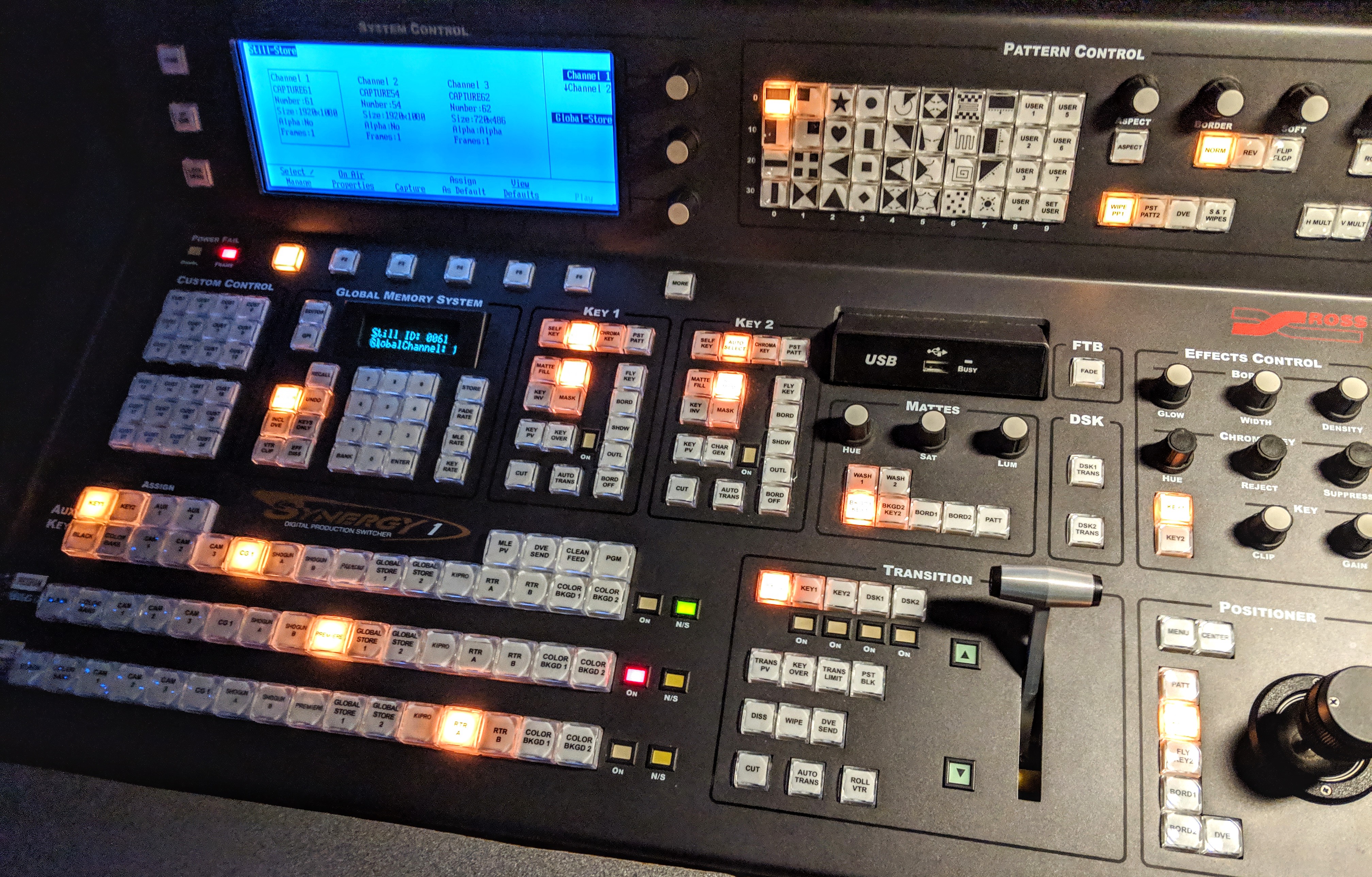
Session 2: After a brief discussion we will visit the TV Studio for training and practice in preparation for recording our shows.

COJO111 Syllabus and Meeting Times

COJO111 Introduction to COJO I

This is the first of a two-course sequence that introduces students to essential skills of the communication and journalism discipline. Students will develop skills to communicate thoughtfully, professionally and ethically with a variety of public audiences. Essential writing and public speaking skills are paired so that students master a writing style and then convert that writing to an oral presentation, or vice versa. Students learn how to appropriately and effectively speak and write to academic, professional and citizen audiences. Students are strongly encouraged to complete this course and COJO 112 before taking any 300-or 400-level COJO courses.

Meeting Times and Location Fall Semester 2019:
Monday / Wednesday 9:55 a.m. – 11:35 a.m. Room OEC 303

Download Syllabi:
COJO111 Introduction to COJO I Fall 2019

Course Weeks:
Week 1 | Week 2 | Week 3 | Week 4 | Week 5 | Week 6 | Week 7 | Week 8 | Week 9 | Week 10 | Week 11 | Week 12 | Week 13 | Week 14 | Week 15

Introduction to COJO I – Week 1

Session 1: Today let’s get into the details of the requirements for the Speech of Introduction assignment that was introduced last week.

Assignment 1: Introductory Speech (1-2 minutes)
Due: Week 2, Session 2 (5 points)

Objectives

  1. Get to know another member of the class specifically, and the rest of the class generally (and begin the process of audience analysis)
  2. To get a chance to give a short speech that demonstrates your ability to:
    a) Make good strategic choices in developing your speech for your audience
    b) Organize material effectively, with an Introduction, body and conclusion
    c) Use supporting materials (evidence) effectively
    d) Emphasize using narrative to illustrate your points of view
  3. Observe and critically evaluate how others prepare and present a speech in order to establish the foundations for more sophisticated rhetorical analysis

Logistics

  1. You will be randomly assigned a partner. If there’s an odd number of people in the class then the last group will have three people assigned.
  2. Spend time interviewing your partner in order to find out information about them that can be used in a speech of introduction. Find a compatible time and location for your interviews and document your sessions by recording audio (use a mobile phone, tablet, or laptop) of the interaction, writing notes, and transcribing the recording.
  3. Consult other sources of information to learn more about your partner, perhaps through online profiles or communicating with friends or family.
  4. Using the information gleaned from the interview and other research, prepare a 1-2 minute long speech introducing your colleague to the class. Include at least one story about the other person. Notes may be used, but deliver the speech without reading directly from any documents.

Interviewing Question Strategies

  1. As you prepare to have a conversation with your partner be aware of the questions you might ask.  Questions do not spring serendipitously from our curiosity (though they can), but can and should be a communicative event/strategy in itself.  To help you think about a “considered” question, think of continuum of question forms you can use:
    a) Closed: form a question which needs a one word or very limited answer
    b) Open: form a question that solicits longer responses. In this situation, do your best to ask open questions.
  2. Think of the types of questions you can ask during the interview: recognize that questions can be phrased in a closed to open format.
    a) A question of clarification: if they said something you didn’t understand, ask a question which will lead to understanding
    b) A question of extension: if they said something that you understood but would like to hear more about, this type of question should lead to an extension of their original comments;
    c) Question seeking new information: this is a “left field” question where you may ask them about any topic which was not addressed in the course of their answers thus far.
  1. Prepare a list of starter questions, though don’t be confined by these – they are starters for the conversation!
    a) Consider the “information” you want from your partner (often fairly closed questions: “where did you go to high school?”)
    b) Consider the “opinions” you want to encourage from your partner (more open questions: “how do you like St. Thomas so far?”)
    c) Consider the order in which you want to develop your line of questioning: what will you start with and where will your questioning take you (home and family, educational and professional plans, individual interests and activities, opinions on current issues)
    d) Create a device for taking notes

Preparing the speech

  1. Prepare the opening: what will you say first to begin your speech?
  2. How will you “introduce” your subject?
  3. How will you cluster the content of your speech so it is easy to follow, understand and remember?
  4. How will you end your speech – what will you say last?

Evaluating the speech
You will be evaluated on how effectively you:

  1. Meet the requirements of the assignment
  2. Present the speech within the context of the situation
  3. Effectively engage the audience and deliver the message

Relevant Reading
Read Pages 1–19 of The Speaker’s Compact Handbook (Fifth Edition)

Female education advocate and youngest ever Nobel Prize laureate, Malala Yousafzai, interviewed by Jon Stewart in 2013.

KHUM-FM Program director, music director, and mid-day host Mike Dronkers on How to Interview “Almost” Anyone.

1. Do the research!
2. Follow up on their answers
3. Relevant Ice Breakers
4. Listen!
5. Dead air chicken
6. Bored people are boring / Interested people are interesting
7. Don’t forget to shut up

Session 2: Today we will be presenting your speeches of introduction. You and your partner will sit at the front of the class and introduce each other. Please remember to keep it quick (1-2 minutes).

Introduction to COJO I – Week 2

Session 1: Today we will discuss the requirements and materials for the Narrative Speech assignment.

Assignment 2: Narrative Speech (3-5 minutes)
Due: Week 3, Session 1 (40 points)

Description
Write and perform a 3 to 5 minute narrative speech based on one of your own own personal experiences that you are comfortable sharing with the class. This assignment gives you a chance to practice preparing and presenting a speech and to give and receive feedback from the audience. You will get feedback on your speech from the instructor and one of your classmates.

Overview
The narrative speech is essentially a speech that tells a story. Narrative speeches often deal with a personal experience. We hear this kind of speech from athletes, missionaries, and business leaders, who often have interesting personal stories to tell. For this assignment, you will describe a personal experience.

Requirements
1. Prepare a 3- to 5-minute speech, outlining your major points on note cards or half-sheets of notebook paper.

2. You will describe a vivid experience that has a moral or a lesson, something that touched you intensely, or was funny, interesting, or transformative.

3. Study narrative speaking styles by listening to one or more speeches in a similar format to our in-class example from the Moth Radio Hour

4. Perform the speech to the class on the due date and give feedback to a minimum of one of your classmates.

5. Submit your notes and an outline of your speech as a PDF on Canvas before class on the due date.

Required Reading
The Speaker’s Compact Handbook (Pages 19–32)

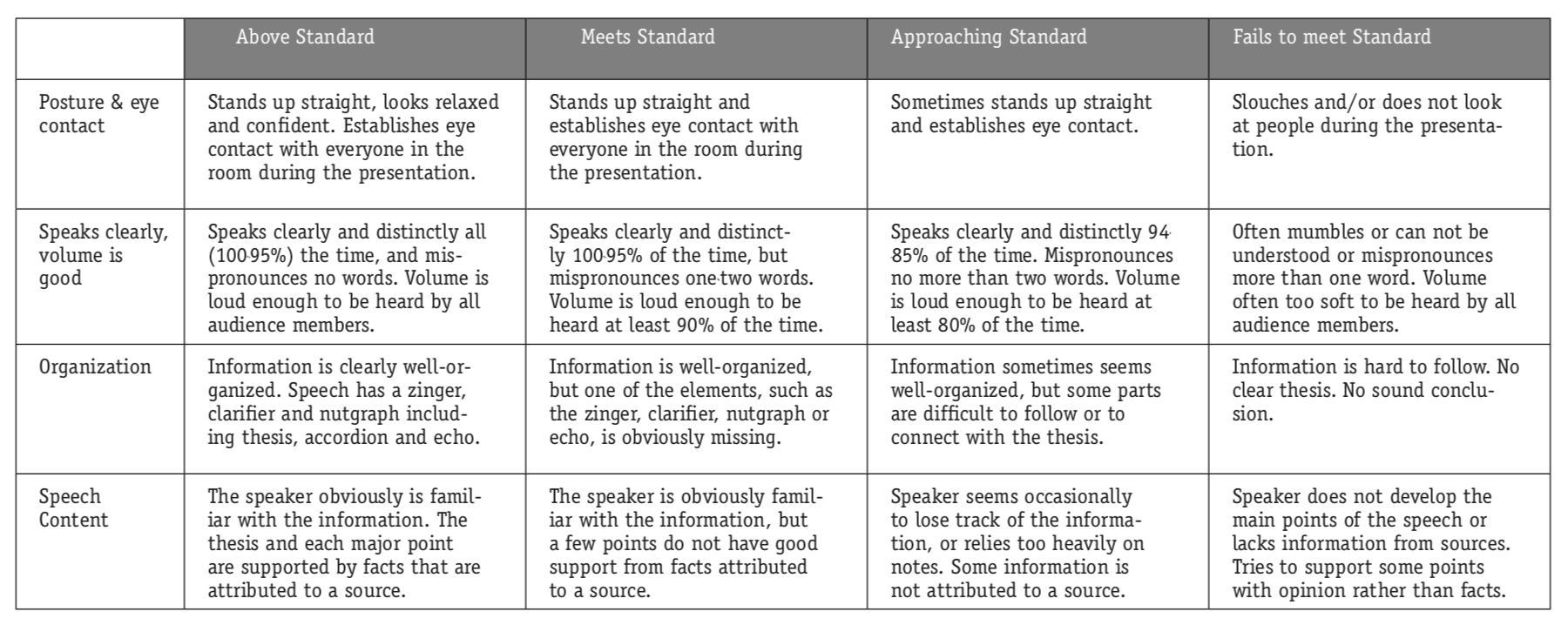
Rubric

Above Standard

Meets Standard

Approaching Standard

Fails to meet Standard

Time-Limit

Presentation is 3–5 minutes long.

Presentation is under 3 minutes or over 6 minutes.

Presentation is under 2 minutes long or over 7 minutes.

Presentation is under 1 minute or over 8 minutes long.

Posture & Eye Contact

Stands up straight, looks relaxed and confident. Establishes eye contact with everyone in the room during the presentation.

Stands up straight and establishes eye contact with everyone in the room during the presentation.

Sometimes stands up straight and establishes eye contact.

Slouches or does not look at people during the presentation.

Speaks Clearly

Speaks clearly and distinctly all (100-‐95%) the time, and mispronounces no words.

Speaks clearly and distinctly all (100-‐95%) the time, but mispronounces one-‐two words.

Speaks clearly and distinctly most (94-‐85%) of the time. Mispronounces no more than two words.

Often mumbles or can not be understood or mispronounces more than one word.

Volume

Volume is loud enough to be heard by all audience members throughout the presentation.

Volume is loud enough to be heard by all audience members at least 90% of the time.

Volume is loud enough to be heard by all audience members at least 80% of the time.

Volume often too soft to be heard by all audience members.

Speech Content

Speech content is concise, creative, and logically organized. The introduction, body, and conclusion are fully developed.

Speech content is creative and organized. The introduction, body, and conclusion are strong.

Speech content is organized. The introduction, body, and conclusion are present.

Speech lacks organization. The introduction, body, and conclusion are present, but not fully developed.

Session 2: Today you will be taking the GPS Pre-Test on Canvas. There will be no preparation or review for this quiz. This is a practice test and your results will not impact your final grade. The goal is to get an idea of what you already know about English grammar and punctuation. A similar test for credit will be given in Week 14 after all the study guides, assignments, and readings have been completed.

Following the test we will look at the Poynter Language Primer as described in the syllabus. This test will be taken online and offers two attempts to get a passing grade of 80%.

Introduction to COJO I – Week 3

Session 1:Today you will be performing your Narrative Speech. It is possible that we will not be able to finish all the speeches today. In that case the remaining speeches will be performed on Session 2.

Session 2: Today, after any remaining speeches are performed, we will be discussing the requirements for the Informative Speech.

Assignment 3: Informative Speech (3-5 minutes)
Due: Week 4, Session 2 (40 points)
Outline Format Worksheet

Description
The purpose of an informative speech is to share reliable factual information that you have acquired through research. It is not intended to promote a policy or opinion; rather, it seeks to provide a foundation for people to better understand a topic that relates to them. This project offers an opportunity to practice your research, writing, organizing and speaking skills. This is a type of speaking used by professionals. You will: thoroughly research and understand a topic; create a clearly organized speech; practice an enthusiastic, dynamic style of delivery; and seek to provide interesting and useful information to the audience.

Requirements
1. Length: 3-5 minutes. An outline is required. Note cards must be used.

2. Electronic sources must be authoritative and credible.

3. Use a minimum of three sources, including one “expert” interview from a print or online source.

4. Turn in a speech outline with a Works Cited Page, MLA format, on the day of the speech as a PDF on Canvas.

Required Reading
The Speaker’s Compact Handbook (Pages 33–74)

Rubric:

Introduction to COJO I – Week 4

Session 1: Today we will be covering more materials that support the Informative Speech assignment. We will start by looking at the reading in the Speaker’s Compact Handbook and then move on to a discussion about your topics and how you might narrow the scope in order to meet the time constraints.

Informative Speaking Guidelines (PDF)

Session 2: Today we will work in groups looking at your outline rough drafts for the Informative Speech. Please compose your outlines using Google Docs so you can share the document with me and your classmates. Please use the Informative Speech Outline Format Guide that I handed out in class last week.

The following infographic illustrates a set of search techniques that drastically help narrow your search results and get you the information that you’re after while doing research online.

Get More Out Of Google