Session 1: Today we will begin our discussions about the Public Service Announcement project. Ask yourself what do you want your audience to know? What do they need to know? How do you get your message across? Is the message timely, relevant, helpful, engaging? All of these questions should be considered when writing a public service announcement. Famous PSAs include Smokey the Bear, “This is Your Brain on Drugs”, and the Incredible Crash Test Dummies.
Assignment #8: Public Service Announcement:
Communicating for a cause
Due: Session 2, Week 12 (20 points)
Dikembe Mutombo, a former NBA player, speaks in a PSA for the Centers for Disease Control about the ebola crisis.
This assignment emphasizes four skills:
- writing succinctly;
- being informative or persuasive;
- writing for the ear; and
- speaking and appearing in a professional manner on television.
Script must be turned in the day before class by uploading it to your portfolio.
Logistics:
- Consider what are the major informative needs surrounding your topic, or what changes in your topic area do you see as imperative.
- Select the information or the change you want to present in your PSA.
- Adopt an “angle” that can be accomplished in a 1-minute piece.
- Write a one-minute public service announcement about that topic.
- Write enough copy for one minute on air; try to be exact. That means you have about 150 words.
Tips:
- Practice reading aloud as you write to get a sense of how many words you can comfortably read on camera.
- As you write, remember that you’re writing for ears, not eyes. Use a conversational tone and plain English. Avoid words that will trip up your tongue.
- You should appeal to the two cognitive dimensions of the listener: their sense of logic and reason, and their affective dimension (their emotions).
- What do you want them to understand by the end of your PSA or what behavioral change would you like to see enacted?
- Have a strong sense of purpose and a clear goal for your communication.
On television:
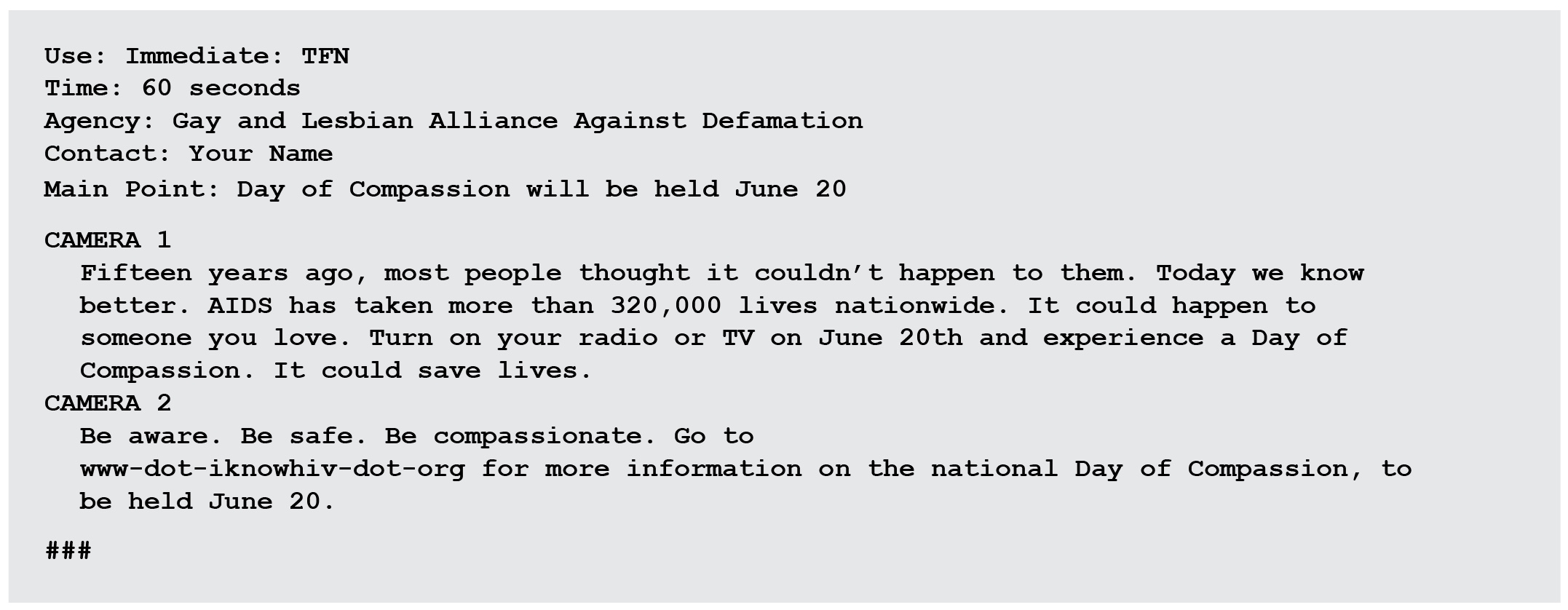
You should decide where in your script you will change cameras, from a medium shot to a close up.
- Why do you select the camera movement there?
- Can you write for that camera change?
- Individually practice reading your PSA and then record it on camera at the assigned time.
- You’ll want to appear relaxed and confident.
- Look into the camera and sit up straight.
- Speak slowly and clearly.
- Enjoy seeing how you appear as a presenter.
Audience
The audience for this PSA is composed of viewers of TommieMedia.
- Who makes up your audience for this piece?
- What’s a good way to speak to them?
- How can you best persuade them?
Call to action
Your PSA must include a call to action.
- Example: “Go to www-dot-iknowhiv-dot-org for expert advice on HIV and AIDS.”
- You want listeners to do something as a result of having heard the PSA.
Other details:
Submit the final version of your PSA script the day before we are scheduled to record.
- Submit a Word document to Canvas with your script. Cite your sources in a separate document or comment in Canvas.
- Changes to your script will be accepted no later that 24 hours after the due date.
- You must also bring a hard copy of the script with you, with the camera change noted.
- We’ll determine the dates/times for the presentations in class.
- Those not acting as talent (the reader) will perform other technical duties: camera, audio, tape, floor director, teleprompter, assistant director.
- We’ll watch all of the PSAs during a class period after we have finished recording them.
Key points to remember about the writing:
- Because you have just a minute to reach your audience, the language should be simple and vivid. Take your time and make every word count. Make your message crystal clear.
- Choose one or two points of focus.
- Don’t overload the viewer or listener with different messages.
- List all the possible messages you want to get into the public mind, and then decide on the one or two most vital points.
- For example, if your group educates people about asthma, you might narrow it down to a simple focus point like, “If you have asthma, you shouldn’t smoke.”
Brainstorm.
- This is also a good time to look at the PSA’s that others have done for ideas.
- Get together with your classmates to toss around ideas about ways you can illustrate the main point(s) you’ve chosen.
- If possible, include members of your target group in this process. If you’re aiming your PSA at St. Thomas students, for example, have fellow students take part in brainstorming, rather than family members.
Check your facts.
- Your PSA must be accurate.
- Facts should be checked and verified before submitting the PSA.
- Is the information up to date?
Identify a “zinger.”
- A zinger is whatever you use to grab the listener or viewer’s attention.
- How are you going to keep them from changing the channel or leaving the room when your PSA comes on?
- A hook can be something funny, it can be a shocking statistic, it can be an emotional appeal — whatever makes the listener or viewer interested enough to watch or listen to all of your PSA.
- For example, “If you’re between the ages of 25 and 44, you’re more likely to die from AIDS than from any other disease.”
Basic guidelines for PSA format:
- The top of the page should list:
- how long the PSA should run, for example: “FOR USE: Nov. 18 – Dec. 20” or “Immediate: TFN” (til further notice);
- length of the PSA: For this class, 1 minute;
- the agency or group sponsoring the PSA; and
- your name.
- The bottom of the sheet should be marked with ###, the standard ending.
Sample PSA script
Rubric
| Criteria | Ratings | Pts | |||||
|---|---|---|---|---|---|---|---|
|
This criterion is linked to a Learning Outcome On-camera presence |
|
||||||
|
This criterion is linked to a Learning Outcome Volume and diction |
|
||||||
|
This criterion is linked to a Learning Outcome PSA content |
|
||||||
|
This criterion is linked to a Learning Outcome Length |
|
||||||
|
This criterion is linked to a Learning Outcome Script |
|
||||||
|
Total Points: 40.0
|
|||||||
Session 2: After listening to your Digital Audio News stories we will continue discussions regarding the PSA assignment.